Why Does Shaula Turn Into a Scorpion?
Shaula turns into the Crimson Scorpion because the Pleiades Watchtower's rules force its guardian into a lethal enforcement state when they are broken.

Shaula turns into the giant scorpion because the Pleiades Watchtower's rules compel its guardian to punish rule-breaking. The change is not a voluntary power-up: when the tower's enforcement conditions are triggered, Shaula is forced into the witchbeast form known as the Crimson Scorpion, and her normal humanlike judgment is overwhelmed.
The transformation determines whether Shaula truly dies at the watchtower.
Spoiler warning: This article covers the anime's Pleiades Watchtower conflict, the later Arc 6 prose ending, and a later web-novel appearance.
Shaula's transformation is a punishment mechanism, not a choice
The easiest way to misunderstand Shaula is to treat her scorpion form like an ordinary battle transformation. Arc 6 establishes something more restrictive. Shaula can live, speak, joke, form attachments, and follow Subaru around in her humanoid form, but she is also bound to the Pleiades Watchtower by orders that take priority over what she personally wants.
When a relevant tower rule is broken, the enforcement system activates through Shaula. She does not weigh the circumstances, decide whether the offender deserves mercy, and then transform. She recognizes the violation automatically and is compelled to act. The penalty is effectively built into her role as guardian.
That is why her later hostility toward Subaru's group is tragic rather than a simple betrayal. Shaula likes Subaru, identifies him as her "Master," and wants him to remain with her. Yet those feelings cannot cancel the older obligations attached to the tower.
The most accurate answer, then, is not merely "Shaula becomes a scorpion when she gets angry." She becomes the Crimson Scorpion because the watchtower's command structure can override Shaula herself.
What Shaula is guarding at the Pleiades Watchtower
Shaula has spent roughly four centuries connected to the Pleiades Watchtower and the Great Library Pleiades. Before Subaru's party reaches the tower, she is also the terrifying long-range defender responsible for making the surrounding Augria Sand Dunes so dangerous. Her supernatural sniping is part of the tower's external defense.
Inside, however, Shaula is not the person who designed every Trial or the ultimate authority over the structure. Her role is closer to an assigned keeper who must preserve the tower and enforce conditions imposed on its challengers. This distinction matters because it explains why she can be surprisingly unhelpful about the tower's deeper mysteries while still being terrifyingly effective when a rule is violated.
Her relationship with Subaru creates a second layer. Shaula treats him as the master she has waited centuries to see again, associating him with Flugel. Arc 6 deliberately leaves larger questions around Subaru, Flugel, and their connection unresolved, so Shaula's recognition should not be treated as proof that "Subaru is Flugel." What is confirmed is that she responds to Subaru as her master and is emotionally devoted to him.
That devotion makes her guardian programming more painful, not less important. Her personal loyalty tells her to protect or obey Subaru. The tower's standing orders tell her what she must do if its rules are broken.
The tower's rules outrank Subaru's commands
Shaula eventually explains four major prohibitions governing challengers. They cannot simply leave before properly completing the Trials, cannot violate a Trial's rules, cannot disrespect the Libraries, and cannot cause destruction to the tower itself.
The important part is not just the wording. Shaula explicitly indicates that these orders have higher priority than a promise she makes to Subaru not to harm his companions. In other words, Subaru can give Shaula ordinary instructions because she accepts him as her master, but that does not grant him administrator access to the watchtower's underlying penalty system.
Arc 6 later exposes an important concealed condition: destroying the Trials themselves is not forbidden. Shaula had hidden this loophole because it could help the challengers escape the system and end the reunion she desperately wanted to prolong. That hidden exception becomes strategically important to Subaru.
It is better to describe this as a hierarchy of commands than as one magical "scorpion order." Shaula has her personal obedience to the person she recognizes as Master, and above it sit the binding watchtower directives. When those directives require enforcement, her preferences lose.
The exact rule violation responsible for every activation is not always presented with a neat label. During the escalating crisis in the tower, the text makes the core causal point clear: someone breaks a rule, and Shaula is forced into the penalty state. Assigning every transformation to one specific offender or one confidently named violation goes beyond what the narrative always spells out.
What the Crimson Scorpion actually is
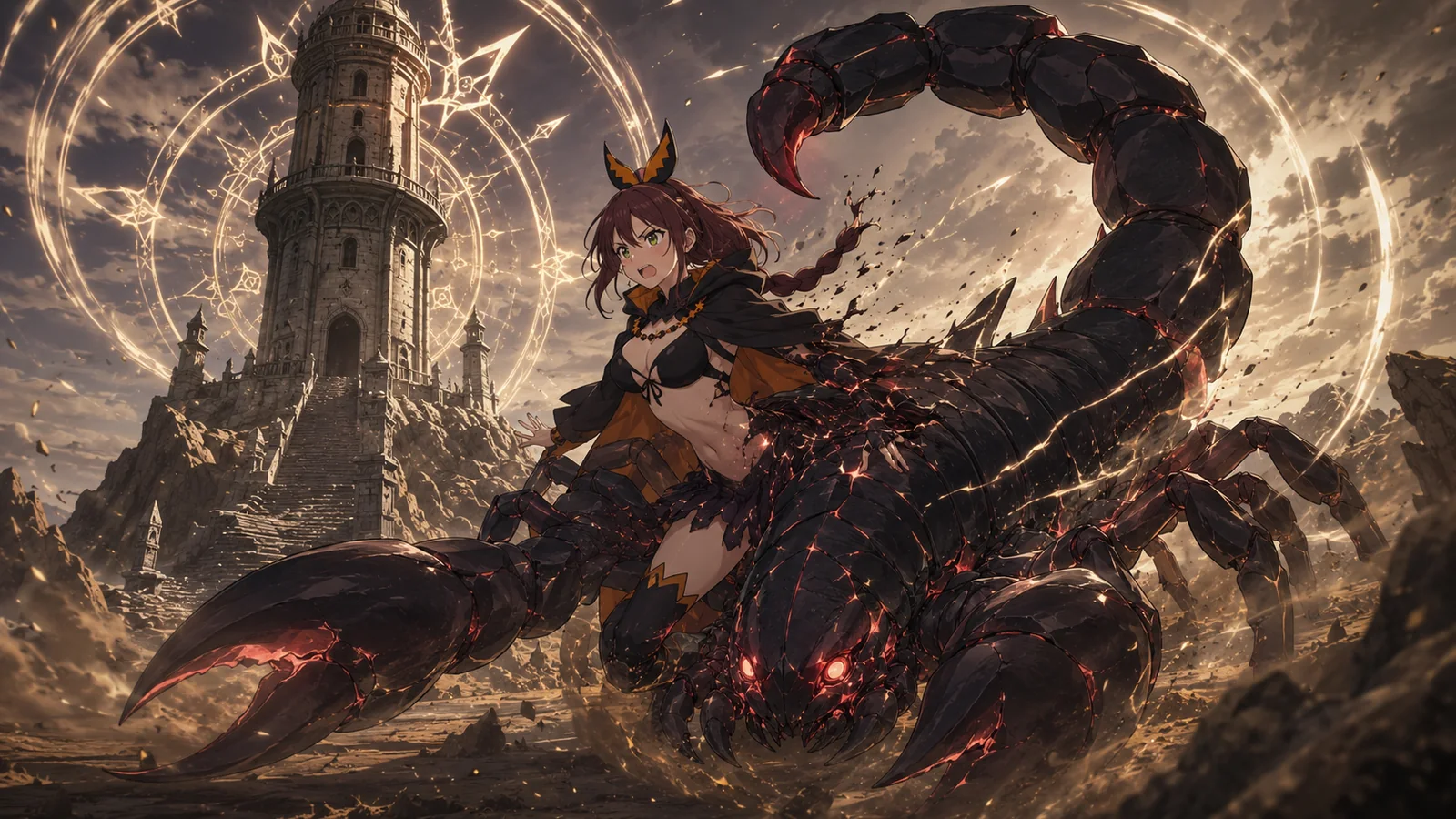
The Crimson Scorpion is Shaula's colossal witchbeast form, not a separate creature that possesses her. Her humanoid body is remade into an enormous scorpion with a hard dark carapace, glowing red compound eyes, huge pincers, multiple legs, and a tail capable of firing devastating attacks.
The name can create another misconception. "Crimson Scorpion" does not mean the creature is bright red at every moment. Its normal giant form is depicted with a jet-black carapace and red eyes. When pushed further, it can enter an Attack Hue, in which the dark shell shifts toward blood red and its aggression increases.
Those are two related but distinct states:
- Crimson Scorpion transformation: Shaula is forced from her humanoid form into the giant scorpion guardian form.
- Attack Hue: the already-transformed giant scorpion intensifies further, with its coloration changing and its combat behavior becoming more ferocious.
The later tiny red scorpion is a third condition and should not be grouped together with either of these.
Why Shaula loses control when the transformation starts
Arc 6 makes Shaula's lack of consent unusually explicit. Before one full transformation, she realizes what is happening while she can still speak and think as herself. She is frightened by what she is about to do and tries to get Subaru to stop the outcome before her conscious control disappears.
That scene is crucial because it separates intent from action. Shaula does not secretly resent the group and use the tower's rules as an excuse. She understands that the giant scorpion will attack people she does not want to kill, including Subaru, and she cannot simply choose to remain in humanoid form.
Once the transformation completes, the Crimson Scorpion behaves like the lethal enforcement mechanism Shaula warned them about. The familiar, impulsive, affectionate personality is no longer making ordinary choices. It targets challengers and attacks with the overwhelming force expected of the tower's guardian.
Even here, "Shaula is erased" is stronger than the story proves at that moment. During the climax, Subaru is able to perceive a faint sense of Shaula through Cor Leonis. The safest reading is that her conscious agency has been suppressed or rendered inaccessible while the witchbeast's enforcement behavior dominates. The story preserves the emotional possibility that something of Shaula is still there, even when she cannot answer him as herself.
That is why Subaru refuses to reduce the problem to "kill the monster." From his perspective, the monster attacking them is still Shaula, trapped inside a function she never freely chose.
How the Crimson Scorpion fits into Arc 6's final crisis
The transformation becomes especially dangerous because it does not happen in isolation. Arc 6 turns the Pleiades Watchtower into a multi-front disaster: the Trials are unstable, Gluttony is involved, Reid Astrea takes over Roy Alphard and becomes a threat beyond the role expected of an examiner, witchbeasts converge on the tower, and other catastrophic forces enter the conflict.
Across Subaru's failed loops, Shaula's transformation becomes one more seemingly impossible element to solve. Merely surviving the scorpion does not fix the system that causes Shaula to transform, and defeating her by brute force would sacrifice the person Subaru is trying to save.
The successful approach therefore depends on understanding the rules rather than treating Shaula as the root problem. The concealed exception concerning the destruction of the Trials gives Subaru a way to think beyond the tower's intended procedure. Emilia's progress through the tower and the group's simultaneous battles push the situation toward breaking the old arrangement instead of endlessly obeying it.
Shaula still fights as the Crimson Scorpion during the climax, and the battle does real damage. The important narrative point is that her role has inverted: the woman who wanted nothing more than to stay beside her master has become an automatic obstacle to his survival. Arc 6 uses the transformation to show how cruel absolute obedience can become when the person carrying out an order has no right to refuse it.
The small scorpion after Arc 6 is not the same transformation
At the end of Arc 6, Shaula does not simply switch from the giant Crimson Scorpion back into the familiar woman Subaru met at the tower. Her post-climax condition is much smaller and much more unsettling: she is reduced to a tiny crimson scorpion.
This is not the ordinary giant guardian form at miniature scale, and it is not Attack Hue. It is a new post-battle state that follows the collapse of Shaula's previous situation at the watchtower. The tiny scorpion does not resume Shaula's speech or ordinary humanlike life. That absence is not proof that every trace of her consciousness or soul has been destroyed.
Meili Portroute becomes the natural person to keep it close. Her Divine Protection related to witchbeast control makes her presence particularly compatible with the small creature, which is drawn to her and can be handled around her. The arrangement also gives the remnant of Shaula a place among Subaru's allies rather than leaving it behind as an abandoned monster.
The web novel's Arc 10 includes the little crimson scorpion with Meili, moving and taking part in events. That is a later web-novel appearance, not an anime scene or proof that every version stages its return identically.
The creature's activity does not establish that Shaula's former memories and humanlike consciousness have returned. Her small surviving form and a complete restoration of the woman Subaru knew are different outcomes.
Light novel, web novel, and anime continuity
The Pleiades Watchtower arc reaches its conclusion in light novel Volume 25. The web novel is an earlier version of the story, not an interchangeable transcript of the published books. Its rule explanation and Shaula's farewell provide prose context, while later web-novel appearances should stay labeled as such.
In the TV anime, Episode 81 already includes the giant scorpion among the obstacles confronting Subaru and shows him pressing Shaula about the Trials' rules. The scorpion conflict is therefore part of the anime's Watchtower story, not an entirely unanimated future event.
The little scorpion left after the prose climax is a different development. Its survival at the end of Arc 6 and its later web-novel appearances should not be confused with the giant guardian appearing during the anime's tower crisis.
The important distinction is between Shaula's forced giant form, an escalation during that battle, and the small creature left afterward. None is a simple return to the woman Subaru first met.