Why Did Louis Arneb Call Subaru a Monster?
Louis calls Subaru a monster after experiencing Return by Death through his memories, realizing no ordinary mind should endure repeated deaths and keep moving.

Louis Arneb calls Subaru a monster because experiencing Return by Death from inside his memories destroys her belief that death can be treated as just another experience to sample, discard, or redo. What horrifies her is not Subaru's species or some hidden transformation. It is the fact that he can suffer death repeatedly, retain the trauma, and still choose to move forward for other people.
The reaction makes more sense alongside Louis Arneb's identity and Authority.
Spoiler warning: This article contains major spoilers for Re:Zero Arc 6, especially the late Pleiades Watchtower material covered in light novel Volume 25 and the corresponding web novel chapters.
Louis does not discover that Subaru is literally a monster
The title is easy to misread if the scene is separated from its context. Louis is a Sin Archbishop of Gluttony, and Arc 6 involves powers that tamper with names, memories, souls, and identity. Re:Zero also contains actual nonhuman beings and people altered by supernatural forces. Even so, Louis's use of "monster" is not a canon reveal that Subaru has ceased to be human.
In the Japanese web novel, Louis explicitly reacts to Subaru's history of dying again and again and concludes that a normal human heart should not be able to endure it. The following chapter immediately reinforces that meaning: Subaru reflects that being called a monster does not especially wound him because he already knows his experiences are far outside anything ordinary.
So the word is psychological and moral language. Louis is trying to describe something she can no longer fit inside her idea of a human being: a person who experiences terror on a level she finds unbearable, yet keeps returning to the same struggle.
That distinction matters because Subaru's humanity is the point of the scene. He is frightening to Louis precisely because he is not an invulnerable creature who ignores pain. He feels it.
What Louis actually experiences in Arc 6
Louis does more than learn the abstract fact that Subaru can Return by Death. Her plan brings her into direct contact with the memories and lived experience attached to that ability.
By this stage of Arc 6, Subaru's identity has been split by memory loss. The "Subaru"moving through the tower does not initially possess the accumulated memories of the Subaru his companions know. Louis exploits that fracture. Her scheme depends on separating the amnesiac Subaru from the identity of"Natsuki Subaru," then using Gluttony's Authority to consume what remains useful to her.
The crucial mistake is that Louis treats Subaru's memories as desirable property. She has built much of her existence around consuming other people's lives. Their experiences are things she can taste, compare, use, and discard while searching for what she considers the best possible life.
Return by Death looks like the ultimate prize from that perspective. If failure can be undone, then the search for happiness appears to become consequence-free. Louis imagines a life in which mistakes can simply be overwritten until she reaches the outcome she wants.
Instead, she learns what Subaru already knows: the reset does not make the death unreal to the person who remembers it.
The web novel makes the scale especially clear. Louis experiences more than twenty of Subaru's deaths and realizes that none of them felt painless, distant, or trivial. Each one carried fear, suffering, loss, and the knowledge of people dying around him. The repetitions do not become harmless because another loop follows.
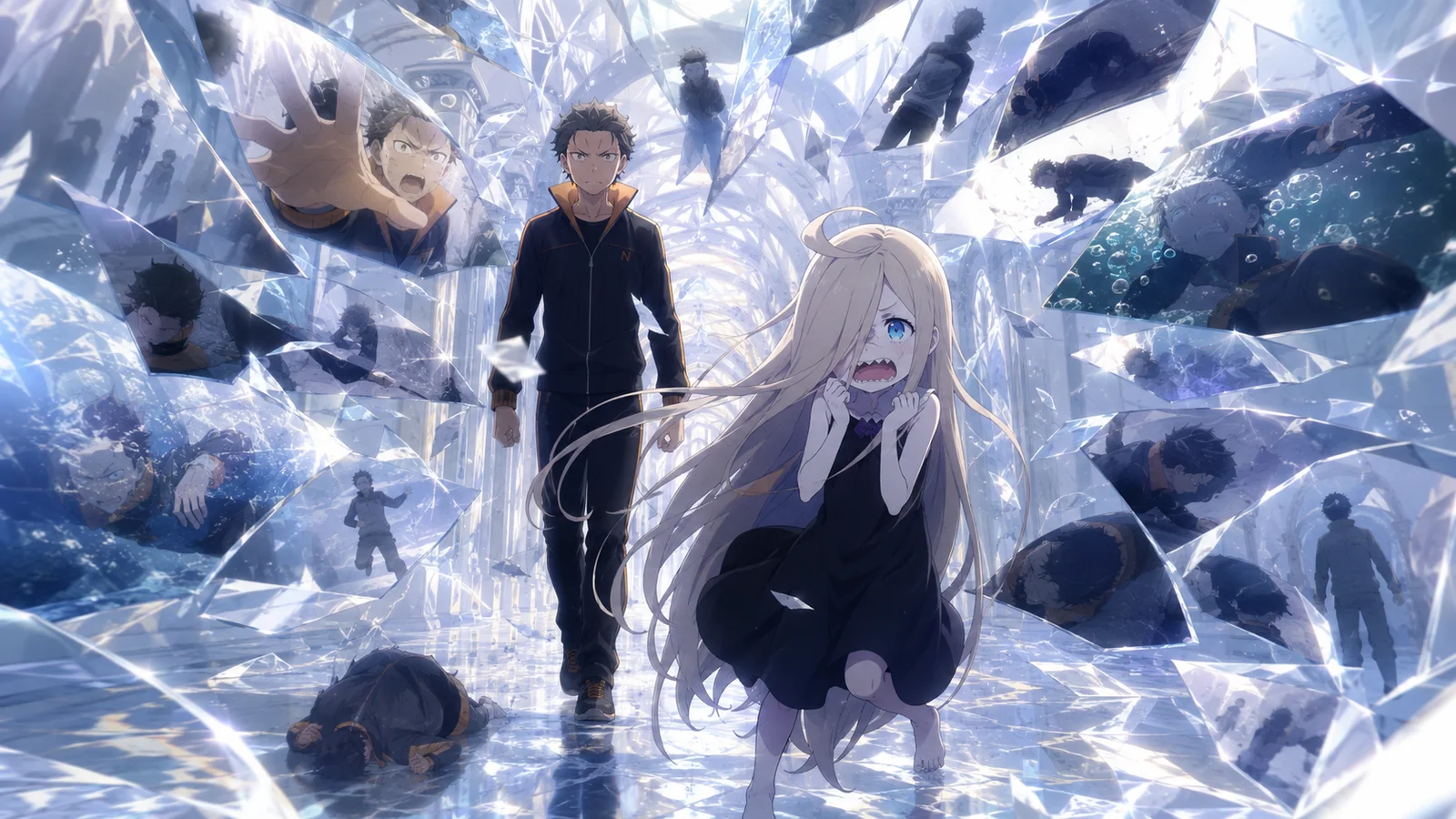
Louis is overwhelmed by the accumulated experience of Subaru's deaths. What terrifies her is that he keeps choosing to continue after experiences she cannot endure.
Return by Death breaks Louis's worldview
Louis's philosophy before this experience is built on appetite and distance.
As Gluttony, she consumes other people's memories and identities while remaining insulated from the full consequences of living those lives as her own. That distance allows her to believe happiness is something that can be acquired by selecting the right experience. A bad life is a bad meal. A better one can be found elsewhere.
Return by Death destroys that logic because it cannot be reduced to a collection of interesting memories.
To Subaru, every failed loop remains part of his inner life even when the rest of the world has been reset. The people who died may be alive again after the checkpoint, but he still remembers losing them. He remembers his own pain. He remembers his mistakes, panic, shame, and helplessness. The world may move backward; his emotional burden does not.
Louis discovers the hidden cost only after she is forced to experience it from Subaru's side.
That is why her desire changes so sharply. Before sharing his deaths, she is fascinated by the possibility of possessing Return by Death. Afterward, the fantasy of an endlessly retryable life is replaced by a primitive fear of dying at all.
The ability she thought would guarantee the "best" life now looks like an inescapable mechanism for repeatedly entering hell.
Why Subaru can keep going when Louis cannot
The scene does not argue that Subaru has a naturally indestructible mind. In fact, Arc 6 goes out of its way to reject that interpretation.
Subaru has broken down before. He panics, despairs, makes irrational decisions, lashes out, and sometimes wants to stop. Return by Death has never made him immune to trauma. His persistence is something he repeatedly rebuilds.
The next stage of the Louis confrontation gives an important explanation. Subaru recognizes the fear consuming her because he has known versions of that same mental prison. What helped him escape it was not superhuman biology. It was other people.
His bonds with Emilia, Beatrice, Rem, and the wider circle of people who have reached for him at his lowest points are part of how he survives psychologically. They give meaning to suffering that would otherwise be meaningless repetition. Subaru keeps choosing painful retries because a successful loop can preserve lives he values.
Louis lacks that foundation. Her relationships are shaped by consumption, self-interest, and the Gluttony siblings' distorted way of sharing lives. Once she personally inherits the terror she previously treated as someone else's experience, she has no equivalent emotional structure to help her process it.
That makes her response a dark mirror of Subaru. She experiences only part of what he has carried and is shattered by the prospect of facing it again.
Why "monster" describes Subaru's persistence
Louis's word choice is therefore less about power than persistence.
Subaru is not terrifying because Return by Death lets him win automatically. It does not. He can be trapped by bad checkpoints, incomplete information, enemies stronger than him, and choices with no obvious clean solution. His victories often require help from people who are stronger, smarter, or better suited to a specific problem.
What Louis finds monstrous is his willingness to re-enter situations that have already killed him.
From her point of view, one truly understood death should be enough to make a person avoid anything that could lead there again. Subaru does the opposite. He carries the memory of what happened, studies the failure, and goes back toward the danger when someone else can still be saved.
That is abnormal, but Re:Zero does not present it as simple fearlessness. Subaru is afraid. The fear remains. His defining trait is acting despite it.
Louis sees the output without understanding the full support system behind it. She experiences the deaths, recognizes the terror, and concludes that the person who keeps accepting that cost must be something other than human. The story's counterpoint is that Subaru's persistence comes from intensely human attachments.
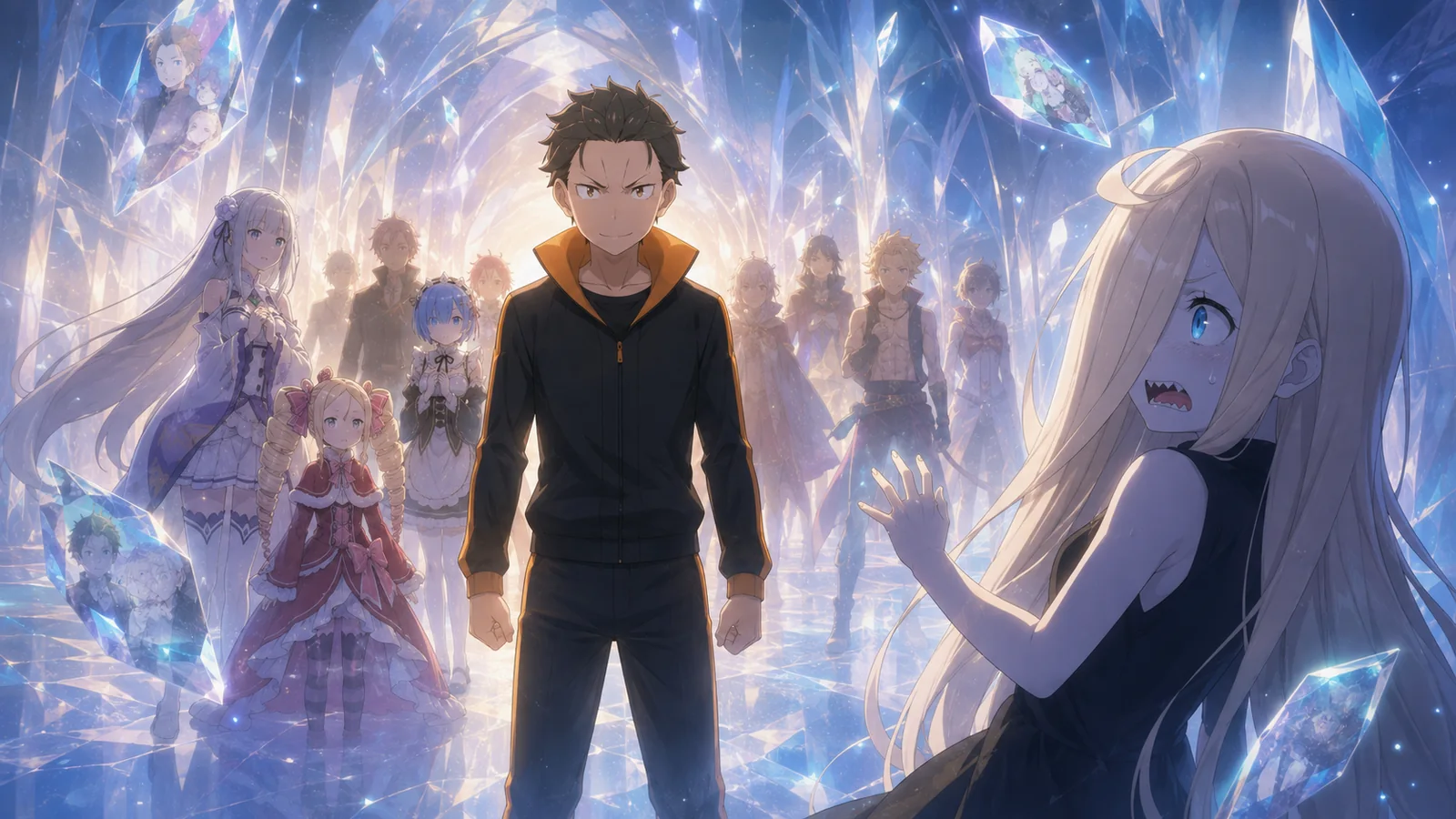
Calling Subaru a monster also misses the relationships that help him endure. His repeated attempts are not evidence that suffering has stopped affecting him.
Louis also learns that Return by Death is not a perfect-life cheat
Another reason the experience devastates Louis is that it strips away the fantasy she projected onto Subaru's Authority.
From the outside, Return by Death can look like the ideal power for someone obsessed with maximizing outcomes. Die, learn, retry, and eventually produce the best route. Louis initially imagines something close to that.
But Subaru cannot casually choose his checkpoints. He does not control every condition around a reset. More importantly, knowledge does not erase emotional consequences. Even a successful final loop is built on memories of failed ones that only Subaru carries.
That makes the Authority almost the opposite of what Louis wants.
She wants happiness without the cost of permanently owning every painful experience. Subaru's power forces ownership. The world may forget a failed timeline, but he cannot simply decide that it did not happen to him.
Arc 6 sharpens this idea through memory itself. Subaru's shame, regrets, failures, and deaths are not disposable contamination surrounding a "better" self. They are part of the person he has become. When his fragmented identity is confronted with those accumulated experiences, the resolution is not to reject them as belonging to someone else. It is to accept that they are his.
Louis, who has spent her existence consuming and rearranging the lives of others, is uniquely unprepared for that lesson.
The web novel and light novel tell the same core story
The clearest wording behind the "monster" question appears in the author-published Japanese web novel's Arc 6 material. There, Louis directly reacts to experiencing more than twenty deaths and says that enduring them is beyond what she believes a human can do. The following chapter opens with Subaru reflecting on having been called a monster.
The commercially published light novel places the same central confrontation in Volume 25. The official English listing emphasizes Subaru's willingness to die as many times as necessary and the discovery of his own Book of the Dead, with Louis's confrontation forming part of the volume's resolution. Exact prose, scene arrangement, and translation choices should be treated according to the edition being read, but the core character point is consistent: Louis's contact with Subaru's death-filled experience transforms fascination into terror.
For anime-only viewers, there is an additional timing issue. Re:Zero Season 4 began in April 2026, and its Recapture Arc started on August 12, 2026. That confirms the anime is moving through this broader source-material territory, but it does not justify assigning this specific late-Arc 6 confrontation to an episode until it actually airs. Any exact adaptation timing beyond announced broadcasts is prediction, not canon.
The manga adaptations should also be treated separately. Re:Zero's manga is not the source the anime follows ahead of the novels, and manga publication progress does not determine when a light-novel scene will appear on television.
What the scene says about Subaru
Louis calling Subaru a monster is one of Arc 6's sharpest reversals because Gluttony begins from a position of superiority. She thinks other people's lives can be consumed and evaluated from above. Subaru's memories force her into the position of the person who actually had to live them.
She expects a powerful Authority and discovers accumulated trauma.
She expects retries to remove consequences and discovers that memory preserves them.
She expects the owner of Return by Death to possess an enviable life and discovers someone who repeatedly chooses suffering because he cannot accept abandoning the people around him.
That is why "monster" works even though it is not literally true. It expresses the distance between what Louis believes a human heart can tolerate and what Subaru has, somehow, continued to tolerate.
The scene also prevents that endurance from becoming a shallow power fantasy. Subaru's strength is not that death stops mattering. Death matters so much that every loop hurts. His persistence is meaningful because the pain remains real to him.
Louis finally understands the cost. What she cannot understand is why he keeps paying it.