Why Are There Two Apothecary Diaries Manga?
The Apothecary Diaries has two official manga adaptations. Here's how the Square Enix and Shogakukan versions differ, and which English edition is which.

The Apothecary Diaries has two manga because Hyuganatsu's novels received two separately produced, officially authorized adaptations: Nekokurage and Itsuki Nanao's version for Square Enix's Monthly Big Gangan, and Minoji Kurata's version for Shogakukan's Monthly Sunday GX. They adapt the same original story rather than forming a sequel pair or splitting the narrative between publishers.
Spoiler scope: publication details and light structural spoilers for material adapted from light novel Volume 4; no endgame character outcomes.
The two Apothecary Diaries manga at a glance
The easiest way to tell the versions apart is by their credits and publishers.
| Manga | Main credits | Japanese home | Official English edition |
|---|---|---|---|
| The Apothecary Diaries | Original: Hyuganatsu; art: Nekokurage; story composition/development: Itsuki Nanao; character concept: Touko Shino | Monthly Big Gangan, Square Enix | Square Enix Manga & Books, The Apothecary Diaries (Manga) |
| The Apothecary Diaries: Maomao's Notes on the Inner Palace | Original: Hyuganatsu; art: Minoji Kurata; character design: Touko Shino | Monthly Sunday GX, Shogakukan | VIZ, The Apothecary Diaries: Maomao's Notes on the Inner Palace |
The official Apothecary Diaries portal lists both comics side by side. Square Enix credits Nekokurage for art and Itsuki Nanao for composition, while Shogakukan credits Minoji Kurata as the artist of the subtitled version.
VIZ also describes the Kurata series as an official adaptation of Hyuganatsu's light novels. Neither manga is a fan project or an unofficial alternate.
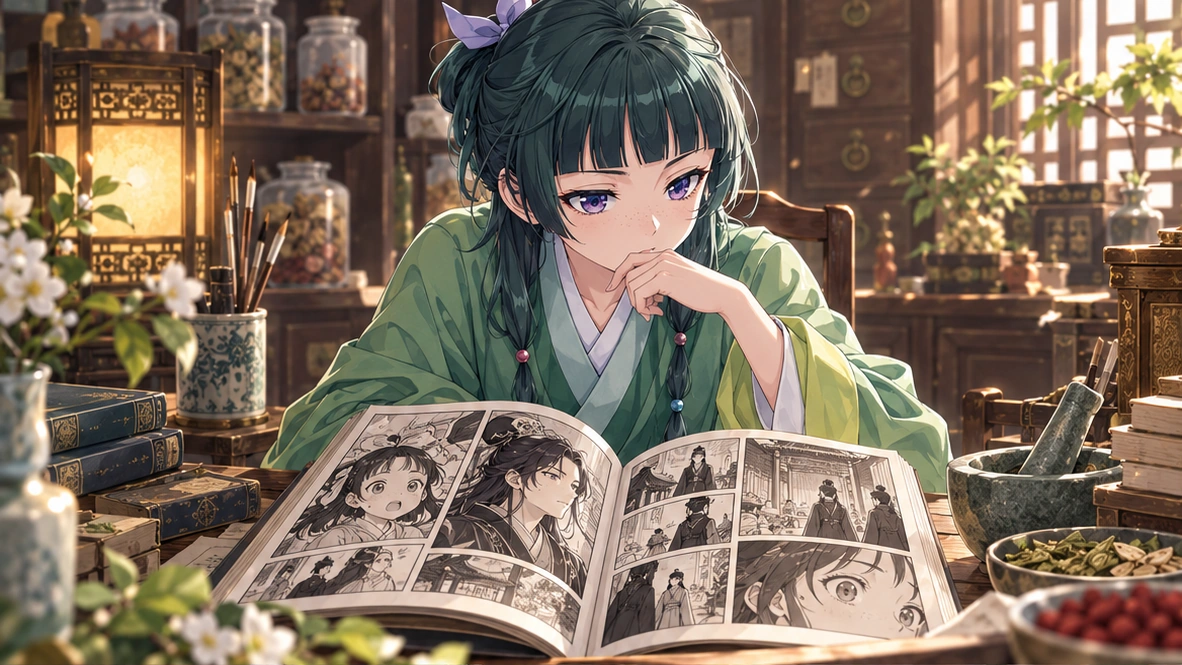
Why were two manga adaptations made?
The official franchise and publisher pages identify both adaptations without explaining the business or contractual arrangement behind them.
It is tempting to repeat fan explanations about overlapping offers, non-exclusive contracts, or publishers deliberately splitting the audience into "romance"and"mystery" camps. Those ideas may sound plausible, but the official pages do not document such a plan.
The supported answer is that two separate publishers produced authorized manga adaptations of the same novel series. The reasons for that arrangement should not be presented as established fact without evidence.
Our guide to whether The Apothecary Diaries story is finished separates the novel, manga, and anime formats.
They share a source, but do not tell every scene identically
Both manga begin from the same material: Maomao is taken from the pleasure district and sold into service in the inner palace, where her knowledge of medicine and poisons pulls her into mysteries involving Jinshi, the consorts, court officials, and the wider imperial household.
That common source explains why major characters, mysteries, relationships, and revelations line up. But "same source"does not mean"same comic."
Each adaptation has its own artist, panel layouts, scene transitions, comedic timing, dialogue compression, and decisions about what deserves a larger visual beat. A clue that occupies a few novel paragraphs can be staged differently in each manga. A character reaction can take half a panel in one version and become the punchline of a page in the other.
These are adaptation choices, not evidence that one book is a sequel to the other.
The visual approach is different
There is no official rule saying the Square Enix manga is "the romance version"and the Shogakukan manga is"the mystery version." That shorthand is too absolute.
Their sample pages do show different artistic approaches. Nekokurage's Big Gangan version tends to use more elastic facial acting and conspicuous reaction comedy. Maomao can switch quickly between composed observation, poison-obsessed delight, and simplified comic expressions. Character chemistry and visual punchlines often receive generous room.
Kurata's Sunday GX version generally reads as more restrained in its acting and denser in its information delivery. Its layouts often emphasize the investigation, with clues, conversations, and setting details sharing more of the page.
These are editorial observations about presentation, not publisher classifications or claims that one version is more accurate. Both retain Maomao's dry intelligence, Jinshi's managed public persona, the palace mysteries, and the relationship undercurrents.
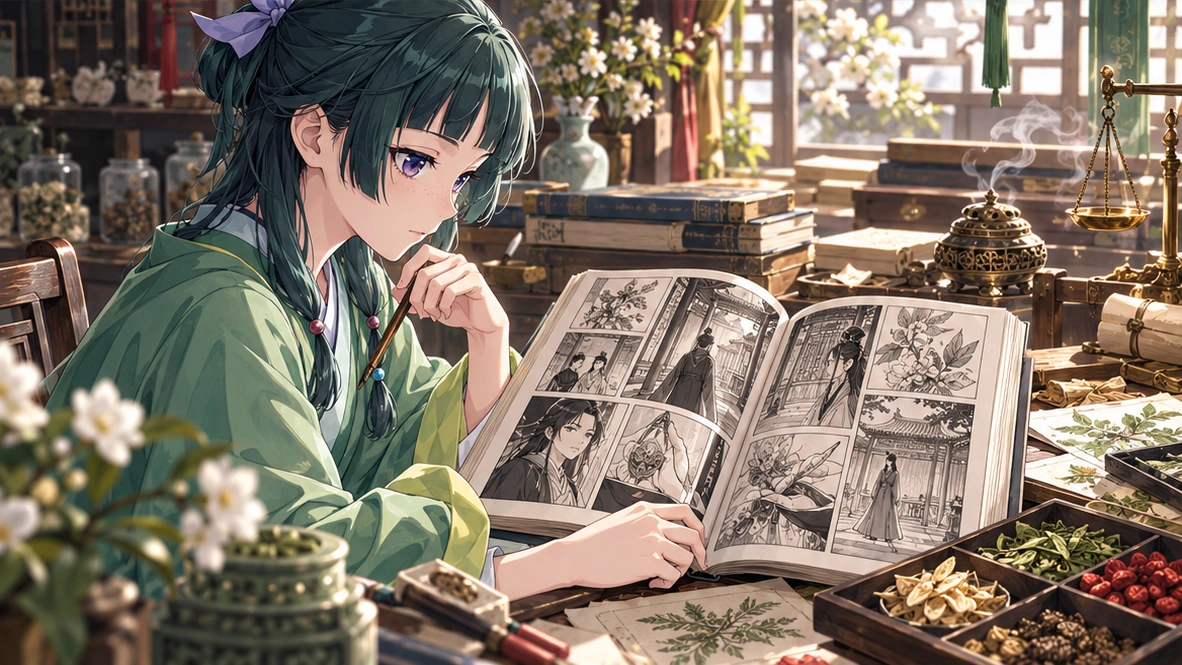
Their pacing is different, but not in one simple direction
Calling one manga simply "faster" needs qualification.
For the opening material, Shogakukan's third Japanese volume states that it completes the material from the first original novel volume. Square Enix's fourth Japanese manga volume says it reaches the end of that same novel-volume material. In that early stretch, the Kurata adaptation packages the source into fewer collected volumes.
That does not create a permanent conversion rate.
Later publisher descriptions show the two adaptations parceling out subsequent arcs differently. Square Enix identifies its Volume 17 as containing the climax of original novel Volume 4, while Shogakukan's Volume 20 describes the corresponding fortress climax. That later correspondence comes from the plot events; Shogakukan's description does not itself label the source as novel Volume 4.
Chapter length, scene expansion, and volume packaging vary. The adaptations make different pacing choices rather than following a universal fast/slow division.
That also matters when you switch formats after learning a plot point elsewhere. For example, when Maomao learns Jinshi's real status can fall at different chapter or volume positions depending on the adaptation.
Which Apothecary Diaries manga is the English edition?
If the book's publisher is Square Enix Manga & Books and its credits name Nekokurage for art plus Itsuki Nanao for story development, it is the Big Gangan adaptation.
VIZ's English line credits Minoji Kurata for art and uses the title The Apothecary Diaries: Maomao's Notes on the Inner Palace. That is the Shogakukan/Sunday GX adaptation, not a reissue of the Square Enix manga.
The Japanese Kurata series also carries the distinguishing Maomao no Koukyuu Nazotoki Techou subtitle. Check the publisher and artist credit before ordering a continuation volume so you do not mix the two lines.
Do you need to read both manga?
No. Either manga can carry you through its adaptation of the novel story without requiring the other as a missing half. They are parallel retellings, not books that alternate chapters between publishers.
Reading both lets you compare how two manga teams interpret the same clues, jokes, palace conversations, and character beats. For a canon outcome rather than adaptation style, such as whether Maomao becomes a doctor, the original novels remain the common source behind both versions.