Does Maomao Become a Doctor?
Maomao becomes Jinshi's de facto physician, but not a formal court doctor. Here's how her medical training and role evolve across the light novel canon.

Yes - in practice, Maomao becomes a doctor, but not in the clean bureaucratic sense that the word suggests. By Volume 9, the light novel explicitly treats her as Jinshi's personal physician in everything but formal title. She takes on serious medical duties, seeks advanced training from Luomen, works alongside court physicians, and becomes involved in high-level clinical care. At the same time, the story keeps calling her an apothecary and preserves the institutional barrier that prevents a woman from simply being appointed as a court medical officer.
That distinction is the answer. Maomao does not abandon pharmacy and receive a neat promotion from "apothecary"to"doctor." Her role expands until physician-level work sits on top of the apothecary identity she already had.
Maomao Begins With Real Medical Knowledge, but Clear Limits
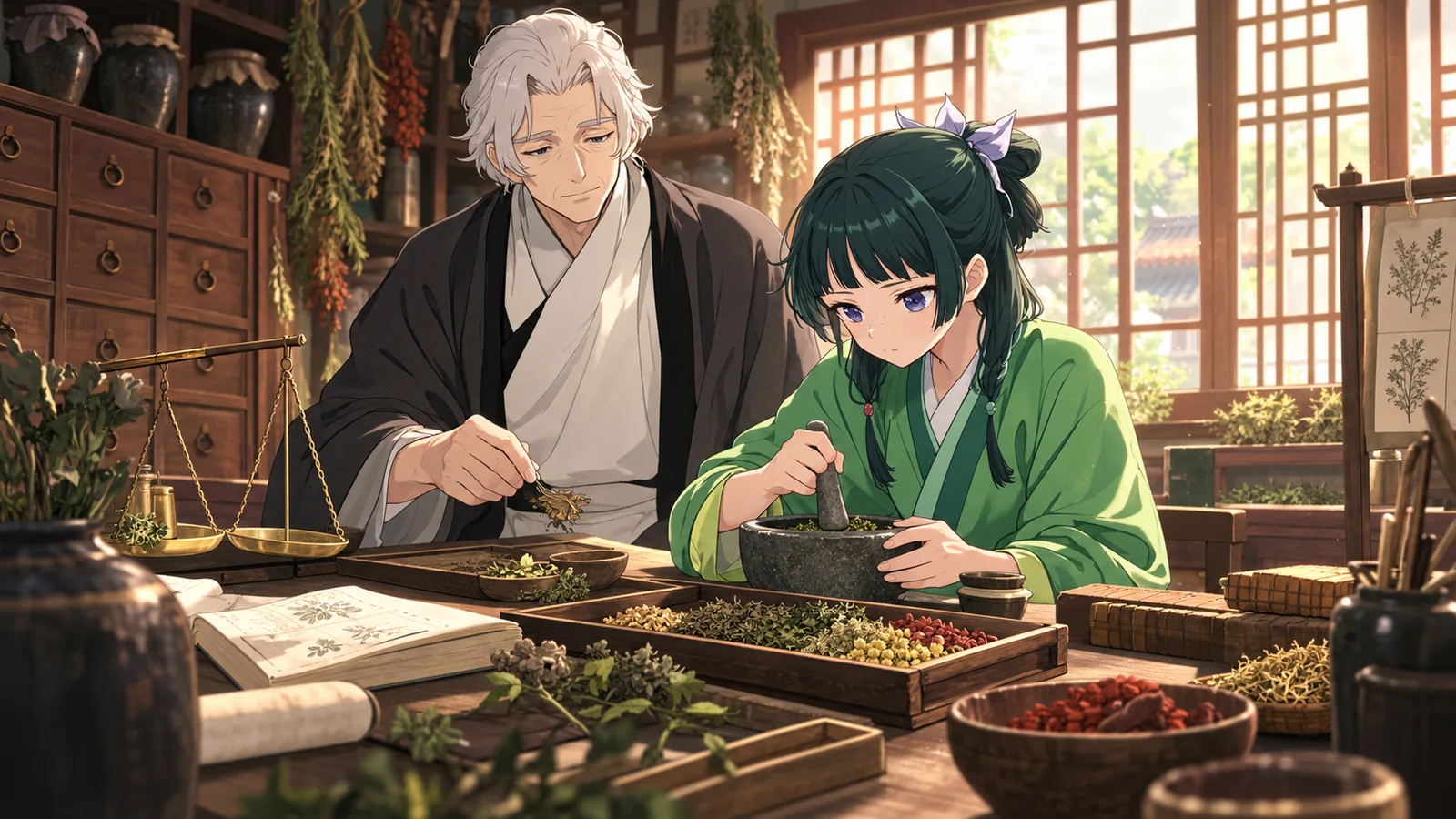
Maomao is not an amateur healer at the start of The Apothecary Diaries. Luomen raises her in the pleasure district and teaches her about herbs, medicines, poisons, symptoms, preparation, dosage, and practical treatment. Her talent for observation makes that education especially powerful: she can connect symptoms with food, cosmetics, drugs, environmental exposure, pregnancy, and poisoning in ways many palace officials cannot.
But the novels repeatedly separate that expertise from full physician training.
Volume 4 gives an early example. When Gyokuyou's pregnancy becomes dangerous, Maomao recognizes that the situation exceeds her ability. Instead of pretending pharmacological knowledge qualifies her for everything, she pushes for Luomen to be brought back into the rear palace. That establishes a boundary the later books take seriously: Maomao may identify danger and understand medicine, but complex obstetric or surgical care requires skills she has not yet mastered.
Her diagnostic strength does not erase that boundary. Maomao is excellent at forming explanations from symptoms and context, but identifying the likely problem is not the same as having the training, authority, or hands-on experience to perform every treatment.
That is why calling early-series Maomao a "doctor" without qualification is too broad. She is an exceptionally capable apothecary with medical knowledge, not a fully trained court physician.
Volume 7 Moves Her Into the Medical Bureaucracy
The major institutional change comes in Volume 7. Maomao passes the court service examination and earns a post as an assistant in a medical office.
She is no longer only the clever apothecary whom Jinshi borrows whenever a mystery smells like poison. She now has an official place inside the palace's medical structure, working around physicians, records, patients, medicines, and procedures that an independent apothecary would not normally access.
Even here, the title is deliberately limited. She is a medical-office assistant, not a court medical officer. In Li, the medical-officer post is reserved for men, so Maomao's duties can grow faster than her formal rank.
Volume 8 Is the Hinge, but Volume 9 Supplies the Answer
Volume 8 is the bridge between Maomao's medical-office appointment and her later physician role. Its official synopsis is dominated by Lakan's Go tournament and the looming locust disaster: Jinshi is trying to turn information and preparation into a defense against a national food crisis. Maomao's medical career is not presented as the volume's headline promotion.
That matters because Volume 8 should not be treated as the point where Maomao receives a formal doctor title. She does not.
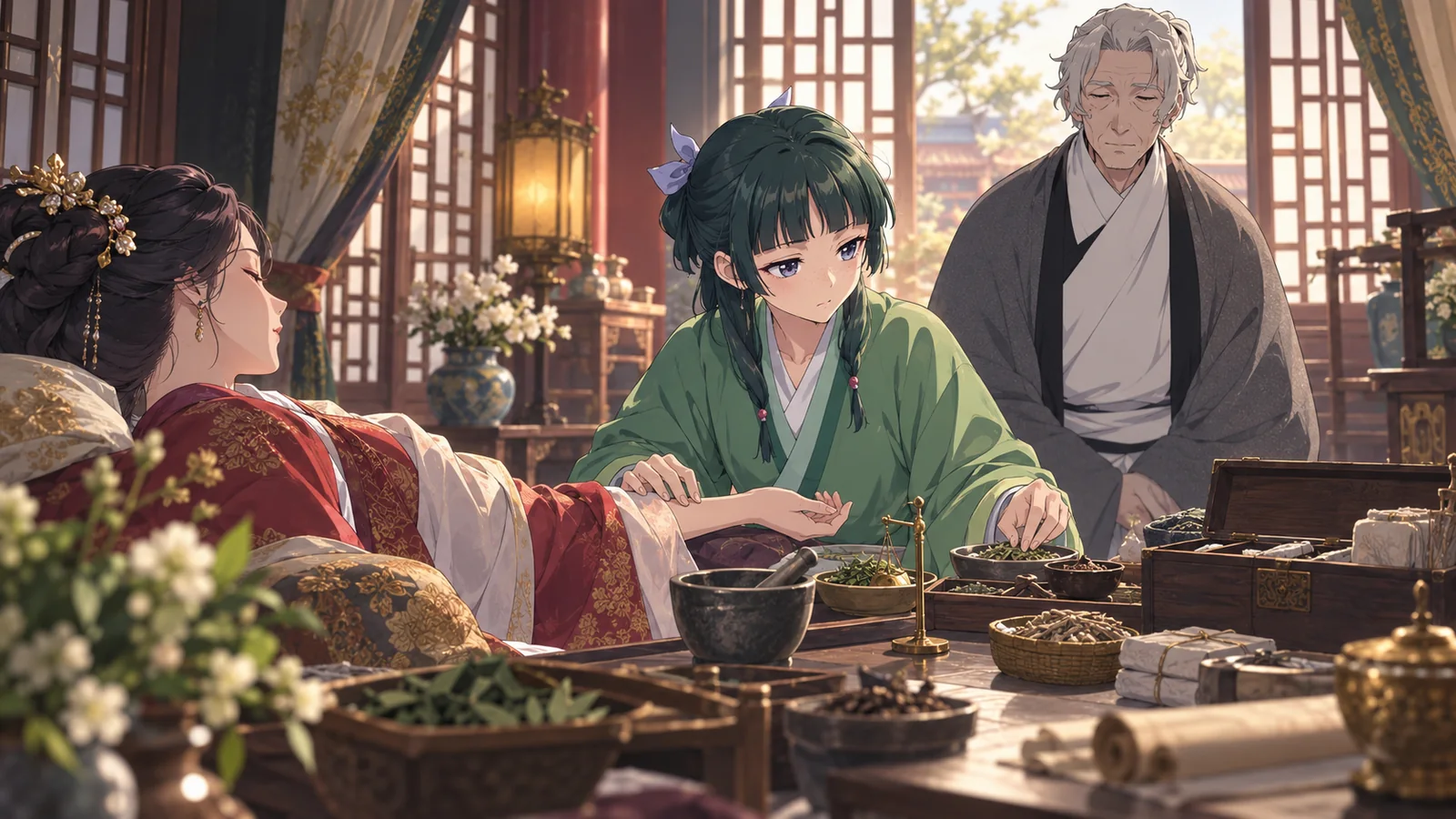
Instead, the medical question becomes unavoidable in the transition into Volume 9. Jinshi has an injury that cannot be openly discussed, and Maomao must visit him secretly to provide what treatment she can. The arrangement exposes the weakness in her position. Jinshi needs someone trustworthy who can do more than compound medicine or recognize symptoms, and Maomao knows that her surgical knowledge is not sufficient for every injury he might suffer.
Volume 9 then states the shift directly: Maomao has effectively become Jinshi's personal physician, even though she is still an apothecary.
That is the clearest canon answer to the question.
If you are also tracking how their professional dependence overlaps with their personal relationship, our breakdown of whether Jinshi loves Maomao covers that side separately.
Why Luomen's Training Becomes Necessary
Maomao's greatest early strengths are pharmacology, toxicology, observation, and practical diagnosis. Those abilities can carry her through poisoning cases and many everyday illnesses, but they do not automatically teach anatomy, surgery, wound management, or the judgment required when a patient's body must be physically opened or repaired.
Volume 9 makes that limitation explicit by describing her surgical skills as inadequate for the level of care Jinshi may require. Maomao therefore asks Luomen to teach her more advanced medicine.
Luomen does not simply hand over advanced knowledge because she is talented or because he raised her. He sets a test before agreeing to train her. That requirement matters: advanced medicine is treated as a discipline that requires preparation, not as another puzzle she can solve through cleverness alone.
The training also exposes her to the guarded practice of surgery at court. Anatomical and surgical knowledge is not treated as freely available information. Access depends on position, supervision, and the willingness to confront procedures ordinary court life prefers to keep out of sight. That is why formal training matters even for someone as gifted as Maomao.
The Biggest Obstacle Is Institutional, Not Intellectual
Maomao's problem is never that she lacks the mind to become a physician. The obstacle is that Li's court does not treat the physician's office as gender-neutral.
Women can work around medicine as assistants and attendants, but the formal medical-officer track is reserved for men. That is why Maomao can perform increasingly sophisticated medical work while retaining an apparently lower or more ambiguous official status.
This gives "Does Maomao become a doctor?"two different answers depending on what"doctor" means.
If "doctor" means someone trusted to diagnose, treat, participate in clinical decision-making, and provide physician-level care, then yes.
If "doctor" means a formally appointed court medical officer with the title, rank, and legal standing attached to that office, then no. The novels preserve a distinction between what Maomao can do and what the bureaucracy calls her.
Her Medical Role Keeps Expanding After Volume 9
The progression after Volume 9 shows that the personal-physician description is not temporary.
| Canon milestone | What changes for Maomao |
|---|---|
| Volume 4 | She recognizes that a dangerous pregnancy exceeds her skills and turns to Luomen. |
| Volume 7 | She passes the court service exam and becomes a medical-office assistant. |
| Volume 8 | Her medical-office role continues while the Go tournament and locust crisis dominate the larger plot. |
| Volume 9 | She effectively becomes Jinshi's personal physician and seeks deeper surgical training from Luomen. |
| Volume 10 | In the western capital, she works both as an apothecary and as a helper to physicians. |
| Volume 15 | She passes an examination, works under Luomen in a large drug trial, and is drawn deeper into advanced medical research and surgical questions. |
| Volume 16 | Her work is embedded in the medical response surrounding the Emperor's successful surgery and the clinical crisis that follows. |
Volume 10 is especially useful because the Japanese publisher's synopsis describes Maomao in two overlapping ways: she works as an apothecary and as a physician's helper. The story does not replace one identity with the other.
Volumes 15 and 16 push that overlap further. Volume 15 places Maomao under Luomen in a large-scale drug trial after she passes an examination, while the surrounding medical project includes cases severe enough to require surgery. Volume 16 opens after the Emperor's successful surgery, with senior physicians taking over postsurgical care while Maomao returns to a demanding medical routine and then faces a smallpox outbreak.
That does not mean Volume 16 identifies Maomao as the surgeon who operated on the Emperor. It shows something subtler: she has become trusted enough to work inside the medical system handling imperial-level treatment, while hierarchy and specialist roles still matter.
Why Maomao Never Stops Being an Apothecary
"Apothecary" is not just Maomao's starter job. It is the professional identity that shapes the way she thinks.
She is interested in ingredients, preparation, dosage, toxic effects, interactions, experimentation, and what a substance actually does to a body. Even when her responsibilities become more clinical, she approaches medicine through that pharmacological mindset. The later novels do not treat this as something immature that she must outgrow.
That is one reason the story's terminology stays intentionally messy. Maomao can be Jinshi's de facto physician while still being an apothecary. She can assist doctors while knowing more than some of them in particular fields. She can receive advanced medical training without holding the office that would normally certify such authority.
Her development is additive rather than replacement-based.
What Is Explicit Canon, and What Is Interpretation?
The explicit canon is straightforward. Maomao is trained as an apothecary by Luomen; Volume 4 establishes limits to her ability in high-risk medical situations; Volume 7 gives her a medical-office assistant post; Volume 9 describes her as effectively Jinshi's personal physician and sends her back to Luomen for deeper training; later volumes keep expanding her clinical responsibilities without simply renaming her a court medical officer.
A reasonable character inference is that "doctor" becomes an accurate everyday description of what Maomao does once she is trusted with serious patients and physician-level responsibilities. That is an interpretation of function, not a claim about her official rank.
The theory line begins when readers predict that the court will change its rules, create a new title for her, or formally recognize women as medical officers. Those possibilities fit themes already present in the series, but they should not be stated as accomplished canon unless a numbered volume explicitly makes that change.
So, Does Maomao Become a Doctor?
Yes, functionally. Maomao grows from an apothecary with unusually broad medical knowledge into a practitioner trusted with work that is plainly physician-level, and Volume 9 explicitly frames her as Jinshi's personal physician.
But she does not cease being an apothecary and receive the standard court-physician title. The novels preserve the tension between her actual competence and the institution's categories. By Volume 16, her medical responsibilities are extensive, her training has deepened, and her place inside court medicine is undeniable - while "apothecary," medical assistant, and de facto physician remain overlapping parts of the same career rather than successive labels that erase one another.