Does Maomao Forgive Lakan?
Maomao never formally forgives Lakan. Volume 2 shows understanding, reunion with Fengxian, and cooperation without replacing Luomen as her father.

No. Maomao does not give Lakan a conventional spoken forgiveness, accept him as her father in the emotional sense, or move into a warm father-daughter reconciliation. The clearest canon turning point is The Apothecary Diaries light novel Volume 2: Maomao learns enough to understand the tragedy surrounding Lakan and Fengxian, then deliberately engineers their reunion. That changes what she knows about Lakan, but it does not replace Luomen in her life.
Maomao can recognize that Lakan did not knowingly abandon a pregnant Fengxian for three years and still resent the consequences of his failures. She can arrange something merciful for him and Fengxian without deciding that he is entitled to her affection. Later volumes keep that pattern: practical cooperation becomes possible, but Maomao still treats Lakan with distance and irritation.
Volume 2 Turns a Simple Villain Story Into a Tragedy
Before the full backstory, Lakan looks easy to categorize. He is a high-ranking military strategist who intrudes into Maomao's life, needles Jinshi, speaks possessively about Maomao, and behaves as though their biological connection should matter to her.
Volume 2 complicates that picture.
Lakan's relationship with Fengxian was not a story of a powerful man seducing a courtesan and deliberately discarding her. Fengxian was a brilliant, difficult woman who could match him at strategy games. Their bond grew through competition, especially Go and shogi.
The obstacle was money. Fengxian's prestige had risen so high that buying out her contract was beyond Lakan's reach. Her answer was a calculated and dangerous gamble: she chose to become pregnant by him, knowing pregnancy would destroy the market value attached to her position as an elite courtesan and could make a buyout possible.
That plan was Fengxian's move. Lakan did not knowingly collaborate in a scheme to lower her price through pregnancy. The tragedy partly comes from the fact that they were not actually planning together.
Lakan Did Not Choose the Three-Year Absence, but He Was Not Blameless
The biggest correction to the "Lakan abandoned them" reading is that his absence was not a deliberate decision to leave Fengxian pregnant.
After Luomen's disgrace, Lakan's own family situation changed. His father ordered him away from the capital. Lakan expected the separation to last roughly half a year, but it stretched into three years. The letters Fengxian sent during that period did not reach him while he was away.
When he returned, he found the accumulated correspondence and understood far too late what had happened.
That does not make him an innocent victim of circumstance. Even before leaving, he had information that should have made him more suspicious, including the collapse of Fengxian's expected buyout arrangement. Volume 2 presents him as brilliant at games and military strategy but disastrously poor at reading emotional implications outside the patterns he understands.
So the canon supports neither extreme. Lakan did not knowingly ruin Fengxian and abandon his child, but his obliviousness and failure to grasp the warning signs helped make the disaster irreversible.
Fengxian's Gamble Collapses While Lakan Is Gone
Fengxian's pregnancy achieved the first part of what she intended: it destroyed her value as the untouchable high-class courtesan men competed over. What it did not produce was Lakan arriving to buy her out.
With him absent, her standing collapsed and the Verdigris House suffered from the scandal. Fengxian's circumstances deteriorated, she contracted syphilis, and her physical and mental condition declined.
Her despair reached Maomao directly. Fengxian cut off part of her own little finger and part of infant Maomao's little finger and sent the grisly message toward Lakan. He did not receive it during his absence. By the time he returned and discovered the letters, the damage had already been done.
That history is why Maomao's feelings cannot be reduced to whether Lakan "deserves" forgiveness. She grew up inside the consequences.
The Madam Protects Fengxian, but Also Keeps Lakan Away
The old madam of the Verdigris House makes the family history even less tidy.
When Lakan returns and rushes to the Verdigris House, the madam reacts with fury. From her perspective, Fengxian has been destroyed after staking everything on a man who disappeared. Lakan arrives after the house has suffered, after Fengxian's life has collapsed, and after Maomao has been born into that wreckage.
The madam does not welcome him back into Fengxian's life. She keeps him at a distance and allows him to believe Fengxian is gone from his reach, while the Verdigris House continues caring for the gravely ill woman in seclusion.
That concealment prolongs the separation, but it should not be confused with causing the original absence. The madam did not send Lakan away or create Fengxian's pregnancy plan. Her choices come after the catastrophe, shaped by protectiveness, anger, and the damage done to the house.
Maomao's Father Is Luomen
For Maomao, biology does not settle the argument.
Luomen is the man who raised her, taught her medicine, protected her, and gave structure to a childhood spent around the Verdigris House. The courtesans there are part of her family environment too. Lakan may be her biological father, but he enters her life as an intrusive man who wants a relationship she never asked him to define.
Her identity was already built before she understood every detail of Lakan's past.
That distinction continues into Maomao's professional life. Her medical education and ambitions come through Luomen, which also matters when tracing whether Maomao becomes a doctor. Lakan cannot retroactively occupy that role just because the blood relationship is real.
Understanding why Lakan was absent therefore does not create an obligation to call him "Father" in the sense he wants.
The Board-Game Wager Is Maomao's Version of Mercy
Maomao's most important action toward Lakan in Volume 2 is not a declaration. It is a maneuver.
She challenges him to a strategy-game match with a wager attached. Lakan's desired reward is revealing: if he wins, he wants Maomao to become his child in practical terms and eventually live with him. Maomao's condition is that if she wins, he must buy out a courtesan from the Verdigris House.
The match includes a drinking penalty that Maomao uses to exploit Lakan's extreme weakness to alcohol. She gets him incapacitated and sends him to the Verdigris House to fulfill the bargain.
Crucially, she does not simply tell him to take Fengxian.
Maomao creates the circumstances in which Lakan can enter the house with the money and obligation to redeem someone, while leaving recognition and choice to him. Meimei then gives him the opening that lets him discover Fengxian is still alive.
Lakan chooses her.
Maomao solves a family tragedy the way she solves many other problems: not through sentimental confrontation, but by arranging conditions and letting people act inside them.
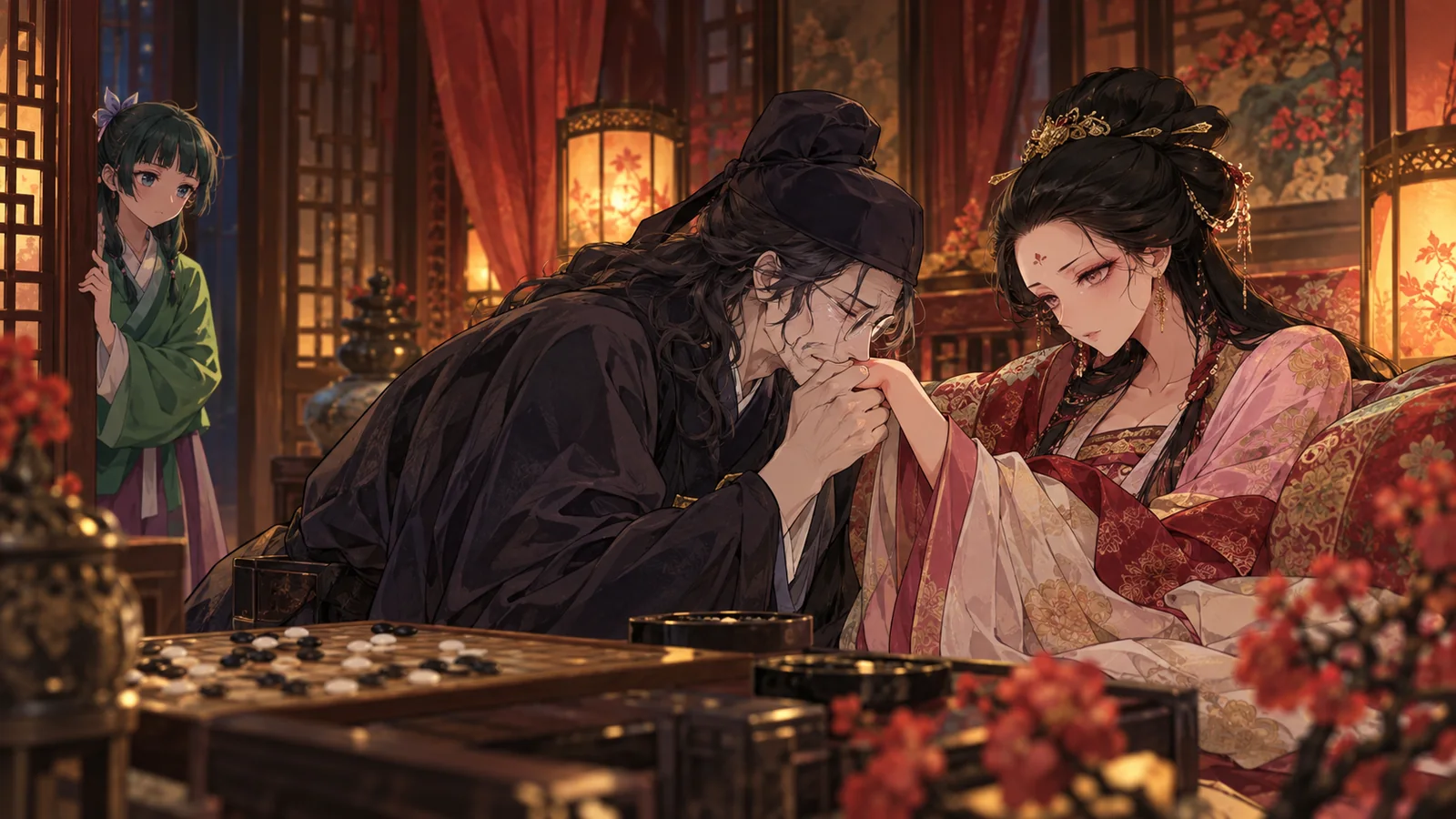
Reuniting Lakan and Fengxian Is Not the Same as Forgiving Him
This is where many summaries go too far.
Maomao's actions show compassion and a more informed judgment of Lakan than simple hatred. But the text never requires the reader to translate that compassion into a full emotional pardon.
She can believe Lakan loved Fengxian. She can understand that he did not know she was pregnant when he was sent away. She can recognize that the letters failed to reach him. She can even give him the chance to repair the one thing that can still be repaired by reuniting him with Fengxian.
None of that erases Maomao's childhood, Fengxian's suffering, Lakan's failures of perception, or the years in which Luomen was the person actually present for her.
The emotional logic is more precise than "she forgives him." Maomao allows the truth to become more complicated without surrendering her boundaries.
Later Volumes Make the Relationship Functional, Not Tender
The light novels reinforce that reading rather than overturning it.
By Volume 7, official publisher material still describes the monocled man as a thorn in Maomao's side. That is not the shape of a completed father-daughter reconciliation.
Volume 8 shows how Lakan can exist inside Maomao's wider working world. His Go book and public tournament become major events, and Maomao is pulled into helping around the competition. She can participate in situations involving him, anticipate his habits, and deal with the consequences of his schemes.
That is functional familiarity, not paternal intimacy.
The relationship becomes less about pure avoidance and more about reluctant coexistence. Maomao knows who Lakan is and why he behaves the way he does. She can work around him when necessary. But she does not replace Luomen with him or seek Lakan out as her emotional parent.
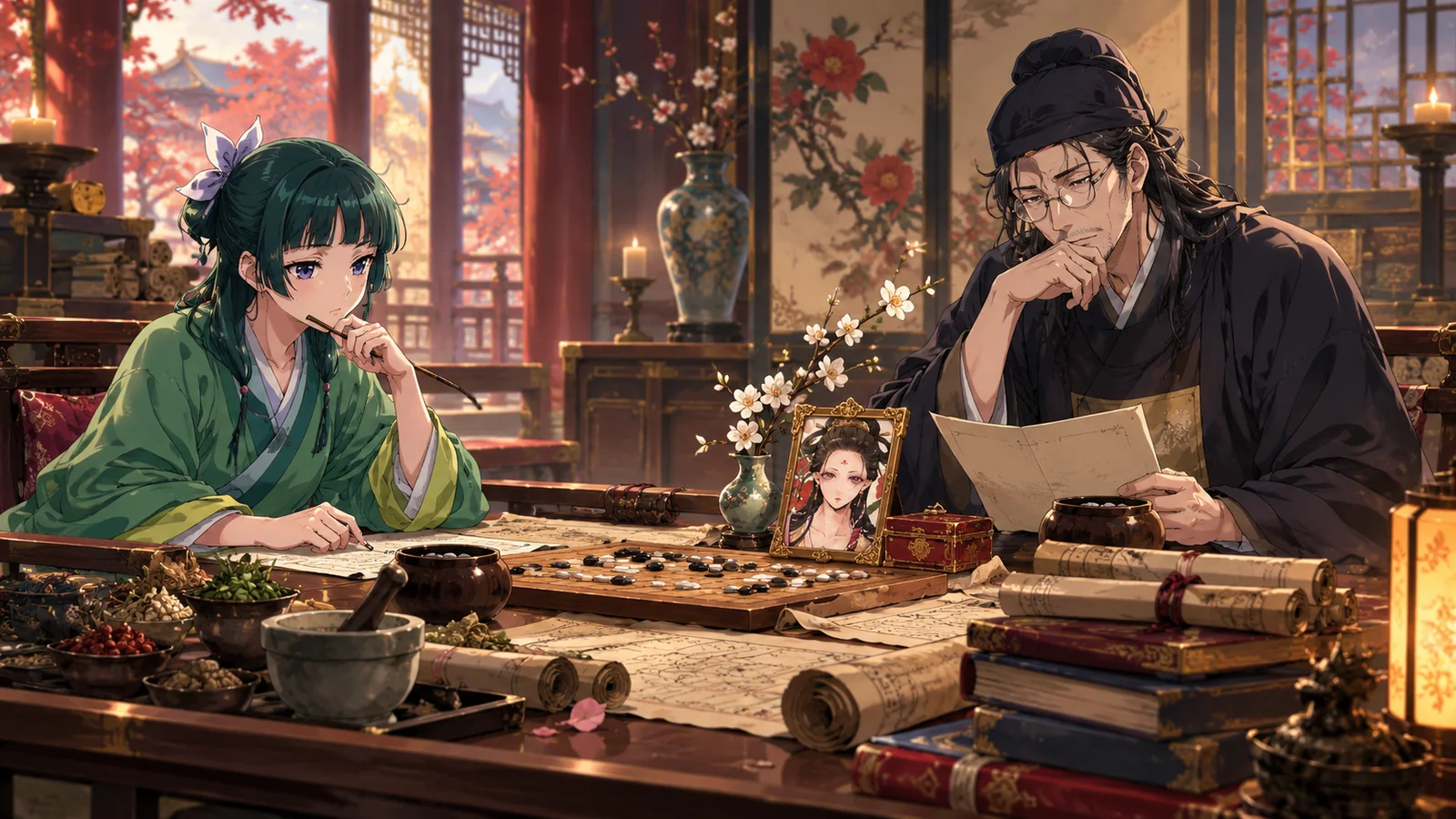
Canon, Inference, and Theory Should Stay Separate
Explicit canon gives the safest conclusion. Lakan is Maomao's biological father. Volume 2 reveals that his separation from Fengxian was shaped by family punishment, failed communication, and Fengxian's own secret plan. Maomao engineers the wager that leads to Lakan and Fengxian reuniting. Later volumes continue to show Maomao interacting with Lakan without transferring Luomen's place to him.
A reasonable character inference is that Maomao's maneuver reflects compassion and a more informed judgment of Lakan than her earlier disgust suggested. She would not need to create that opportunity if she saw him only as a monster.
What remains interpretation is calling that act "forgiveness" in the full emotional sense. The novels do not give Maomao a clean confession that she forgives Lakan, nor do they transform the pair into a conventionally affectionate family unit.
That ambiguity fits Maomao. She often expresses care through action rather than emotionally explicit language. With Lakan, though, the action has a limit: she gives him a chance to reunite with Fengxian, not a claim on her own heart.
Maomao Understands Lakan Without Giving Him Luomen's Place
The best answer, anchored to light novel Volume 2 and reinforced by Volumes 7 and 8, is that Maomao does not formally forgive Lakan or reconcile with him as her true father.
She learns enough to recognize that the tragedy was not a simple abandonment. She understands that Fengxian made her own dangerous choice, that Lakan was forced away and cut off from the crucial letters, and that the Verdigris House later kept Fengxian beyond his reach. She also retains every reason to resent his blindness, his intrusive behavior, and the damage surrounding her birth.
Then she gives him a path back to Fengxian.
That is mercy. It is understanding. It is acceptance that Lakan belongs somewhere in the map of her life.
But Luomen remains her father.