Why Did Hitogami Want Roxy Dead?
Hitogami targets Roxy to prevent Lara's birth and the future threat posed by Rudeus's descendants. Learn why the hidden rat plot depends on her pregnancy.

Roxy Was a Target Because of the Future She Created
Hitogami wanted pregnant Roxy dead to prevent a future in which Rudeus's descendants help Orsted defeat him. In the changed timeline, Roxy survives and gives birth to Lara Greyrat, whose future importance makes that family line a threat. The motive is self-preservation, not a prediction that Roxy herself will kill the Man-God.
The scheme creates the alternate answer to whether Roxy dies.
Spoiler warning: This explanation follows Rifujin na Magonote's original web novel, including the future diary, Lara, and the main-story ending.
Hitogami's concern is not that Roxy will someday challenge him in a duel. He wants to prevent the family and alliances that can grow from her marriage to Rudeus.
After future Rudeus exposes the basement trap, Hitogami explains that his own future has become dangerous. He can see a path in which Orsted is involved in his defeat and Rudeus's descendants are on Orsted's side. That makes Rudeus's family a strategic problem.
Roxy's first child with Rudeus in the changed timeline is Lara. The Sacred Beast Leo chooses her as the beastfolk's savior, giving her importance beyond an ordinary family birth. That later development connects the threatened pregnancy to the future Hitogami fears.
That still does not mean "Roxy kills Hitogami," or that the completed main story shows Lara delivering a final blow. The confirmed point is narrower: Roxy's survival allows a future lineage and alliance that Hitogami sees as threatening to his survival.
Hitogami Had Been Trying to Manage Rudeus and Roxy for Years
Hitogami's plan works because he does not begin with an obvious assassination attempt. For much of Rudeus's life, he appears as an irritating but often useful adviser. Several pieces of his advice produce real short-term benefits, giving Rudeus reasons to keep listening even while distrusting him.
When Hitogami finally explains himself, he makes clear that he had tried to keep Rudeus and Roxy apart. Their connection proved difficult to erase because both are protected by unusually strong fate. In Mushoku Tensei, fate is not a simple prophecy that forces one exact script, but some people and outcomes are much harder to divert than others.
This is why it is risky to assign a secret Roxy-related purpose to every single piece of Hitogami's early advice. The story reveals a long campaign of manipulation, but Hitogami is also a liar, and not every intermediate move is explained with perfect transparency.
What is confirmed is the larger strategy: he attempted to steer events away from the future produced by Rudeus and Roxy, found their eventual union difficult to prevent, and then looked for a moment when Roxy's normally strong fate became vulnerable.
Pregnancy gave him that opening. Hitogami explains that Roxy's fate weakens while she is carrying Rudeus's child. Instead of trying indefinitely to stop Rudeus from loving or marrying her, he can wait until the pregnancy and remove both mother and unborn child at once.
That is the context that turns an ordinary basement instruction into one of the series' most important traps.
The Basement Rat Was Designed to Kill Pregnant Roxy
At Turning Point 4, Hitogami gives Rudeus an apparently minor instruction: go into the basement.
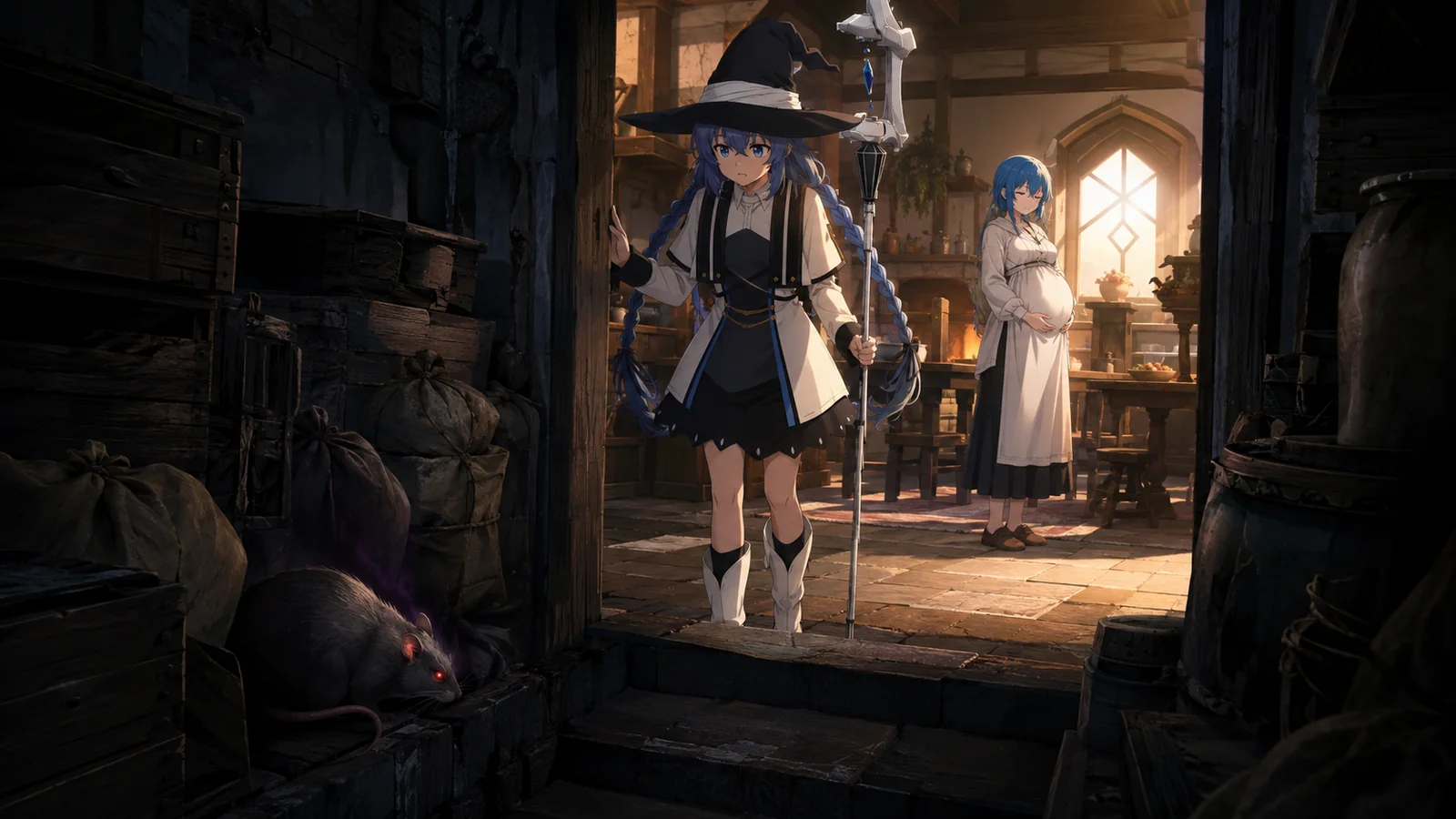
In the future that the older Rudeus originally lived through, Rudeus follows that advice without knowing what is at stake. His action allows an infected rat to escape from the basement. The animal carries a petrifying magic-stone disease and eventually contaminates food that Roxy eats.
Roxy becomes seriously ill. The disease progressively petrifies the victim, and the available treatment is far beyond ordinary healing magic. Future Rudeus, Cliff, Zanoba, and others desperately search for a solution, but they fail to save her in time.
Roxy and her unborn child are lost. In the changed story, the pregnancy continues and her daughter Lara is born.
The rat is not a random tragedy that Hitogami happens to exploit afterward. It is a deliberate setup. Hitogami needed Rudeus to perform one harmless-looking action at the right moment, allowing an indirect chain of events to kill Roxy without Hitogami personally appearing in the physical world.
The Future Diary Shows What Happens When Hitogami Wins
The future diary is essential because it separates two versions of events that are often blended together in summaries.
In the future timeline, Rudeus opens the basement, the rat escapes, and Roxy contracts the petrifying illness. Her death devastates Rudeus and becomes the first major break in a much darker life. Fans commonly call this older version of Rudeus "Oldeus," although that is a fandom shorthand rather than his formal name in the story.
The losses continue. Rudeus becomes increasingly consumed by grief, anger, and his desire to understand and eventually oppose Hitogami. Other people close to him die as the years pass. His relationships collapse, and his life becomes almost unrecognizable compared with the family-centered future he had been building.
Decades later, that Rudeus develops time-travel magic. He cannot simply reset his life without cost: traveling into the past catastrophically damages his body. He reaches his younger self shortly before the basement incident, gives him the diary, warns him about the rat, and leaves instructions intended to prevent the same chain of disasters.
Seven Seas's Volume 15 synopsis likewise centers on averting the future self's losses. The warning turns Oldeus's ruined future into information the younger Rudeus can act on.
She does die in future Rudeus's timeline, but that death is prevented in the changed timeline. The Oldeus comparison separates that loss from the family that survives the warning.
In the Main Timeline, Roxy Lives and Lara Is Born
Armed with his future self's warning, present-day Rudeus does not repeat the mistake. He freezes the basement before opening it, killing the rat before it can contaminate Roxy's food.
Hitogami's scheme therefore fails in the main timeline.
The failure forces their conflict into the open. Hitogami reveals more of why Rudeus's family matters and pressures Rudeus toward killing Orsted. Rudeus prepares extensively for that battle, using the Magic Armor and every advantage he can assemble.
He still loses.
The result is disastrous for Hitogami's strategy: rather than eliminating Orsted, Rudeus becomes his subordinate and ally. Orsted, in turn, agrees to help protect Rudeus's family from Hitogami.
Roxy later gives birth to Lara. The child whose existence the basement plan was meant to erase is now alive inside a household directly cooperating with Hitogami's greatest enemy.

Why Lara Is So Dangerous to Hitogami
Lara's connection to Leo gives the threatened pregnancy a name and a place in the wider story. It does not turn every prediction about her future into an event that has already happened.
There is also a practical reason Rudeus's descendants matter to Orsted: they do not react to Orsted's fear-and-hatred curse in the normal way. Rudeus himself is an anomaly in this respect, and his descendants can cooperate with Orsted without the instinctive hostility that makes ordinary alliances difficult for him.
The web novel's ending still leaves Hitogami active after Rudeus dies. A vision of his eventual defeat is not a completed final battle during Rudeus's lifetime. Nor does it establish that Lara alone defeats him; the threat involves Orsted, Rudeus's descendants, and their allies.
Hitogami's Foresight Is Powerful but Not Absolute
The rat plot can make Hitogami seem omniscient, but his abilities have important limits.
Hitogami can see futures and manipulate people toward outcomes favorable to him. He also monitors his own future, which is how he realizes that Orsted and Rudeus's descendants become dangerous. That foresight allows him to construct plans that unfold over years rather than days.
However, he cannot freely rewrite any destiny he dislikes. Strong fate limits how easily he can eliminate certain people or relationships. Rudeus and Roxy repeatedly resist the future Hitogami would prefer, which is why he waits for the vulnerability created by pregnancy instead of simply arranging Roxy's death at any earlier point.
Most importantly, foresight does not account perfectly for unprecedented disruption. Hitogami successfully produces the future in which Roxy dies, yet that same tragedy creates the older Rudeus: a version of Rudeus desperate and knowledgeable enough to develop time travel and warn his younger self. The plan succeeds once and, through its own consequences, supplies the information that defeats it.
The Anime's Turning Point 4 Milestone
The official Season 3 Episode 11 preview names "Turning Point 4" and describes the advice and mysterious home visitor. It is not confirmation that all of Light Novel Volume 15, or Hitogami's full explanation, appears in that episode.
The decisive distinction is between a plan and its changed outcome: Hitogami tries to remove Roxy's pregnancy from the future, but Oldeus's warning allows Roxy and Lara to live.