Why Couldn't Orihime Repair Ichigo's Bankai?
Orihime couldn't repair Ichigo's Bankai because The Almighty made its destruction part of the future; Tsukishima changed the past so she could reject it.

In the manga, Orihime could not initially repair Ichigo's Bankai because Yhwach had not merely shattered Tensa Zangetsu through ordinary physical damage. Using The Almighty, he altered the future so that the Bankai's destruction was already built into the future confronting Ichigo. Sōten Kisshun could not reject that Yhwach-modified future on its own. Tsukishima solved the problem with Book of the End by inserting a past in which the Bankai had not been broken, giving Orihime a different history from which her rejection could restore Tensa Zangetsu.
The repaired blade returns for the same endgame in which the Still Silver arrow creates an opening.
Major manga spoilers: This article covers the final battle with Yhwach, the nature of The Almighty, Tsukishima's return, and late Thousand-Year Blood War material from the completed manga.
Yhwach Does More Than Physically Break Tensa Zangetsu
The key to the scene is understanding what Yhwach actually does when Ichigo releases his newly forged Bankai during their final confrontation.
Ichigo has already rebuilt Zangetsu after the first Quincy invasion. Ōetsu Nimaiya reforged the Zanpakutō, and Ichigo later reaches Yhwach with a new understanding of his Soul Reaper, Hollow, and Quincy powers. When he finally activates Bankai, Yhwach treats Tensa Zangetsu as a serious enough threat that he refuses to let Ichigo use it normally.
The sword appears broken almost immediately.
That moment is intentionally disorienting because Ichigo does not see Yhwach perform a conventional sword strike that could explain the damage. Yhwach then clarifies the more important part of The Almighty: his power is not limited to observing possible futures. He can interfere with and transform the future he sees.
So the Bankai is not simply damaged in the present and left for Orihime to heal afterward. Yhwach has used his future-altering ability to produce a reality in which Tensa Zangetsu has already been broken.
That distinction is the entire reason the usual solution fails.
What Sōten Kisshun Normally Does
Orihime's Sōten Kisshun is commonly described as healing, but that shorthand undersells how her ability works.
The Shun Shun Rikka's restorative technique rejects phenomena that have occurred within its barrier. Instead of merely accelerating biological recovery or patching damaged matter, Orihime can deny the event that produced the damaged state. This is why her powers have accomplished feats that ordinary healing techniques cannot, including restoring lost body parts.
That makes her an obvious answer to a broken sword. If Tensa Zangetsu had simply been snapped by force in the normal course of battle, the logic of her ability would be to reject the damaging event and return the target toward its earlier condition.
But her ability is not presented as unlimited. Bleach repeatedly connects its effectiveness to the nature of the phenomenon being rejected, the target, and the forces opposing her. Against Yhwach's final use of The Almighty, the problem is specifically temporal and causal.
Orihime is trying to reject damage whose governing event has been imposed through a future Yhwach has already changed.
Why Orihime's First Attempt Fails
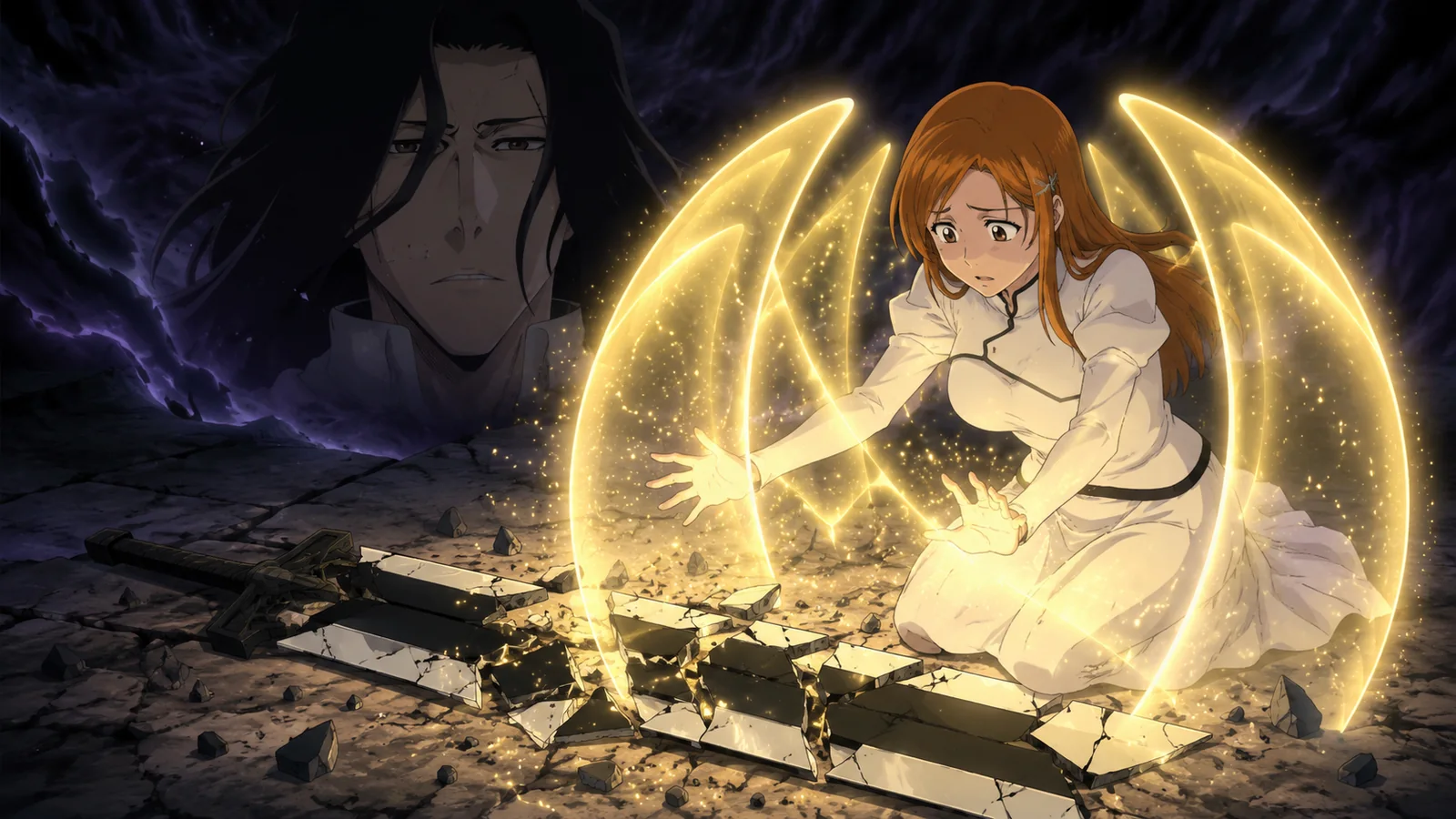
After Ichigo is defeated and Tensa Zangetsu remains broken, Orihime attempts to restore the blade with Sōten Kisshun. Nothing happens.
The manga's explanation is not that Orihime suddenly lacks enough spiritual pressure, nor that her technique has stopped functioning. The obstacle is Yhwach's alteration of the future.
Normally, Orihime can look at a damaged state and reject the phenomenon that led to it. Here, however, the Bankai's broken condition is tied to The Almighty's manipulation of what will happen. Yhwach has made the destruction part of the future itself, placing it outside the straightforward sequence Orihime normally overturns.
This is why saying "Yhwach was stronger than Orihime" is too vague. Superior power is certainly part of the larger confrontation, but the scene gives a more specific mechanical explanation: Sōten Kisshun cannot, by itself, reject the future that Yhwach has altered with The Almighty.
It is also why repeatedly trying the same restoration would not solve the problem. Orihime needs a different causal starting point.
What Book of the End Actually Changes
The solution arrives with Shūkurō Tsukishima and Kūgo Ginjō, returning from the Fullbring arc at a moment when Ichigo has nearly lost hope.
Tsukishima's Fullbring, Book of the End, is a sword-like bookmark with an extraordinary ability: when he cuts a target, he can insert his presence into that target's past. The Fullbring arc demonstrates that this is more than an illusion or memory edit. The altered past becomes functionally real for the affected target, allowing Tsukishima to place himself into relationships and histories that did not previously include him.
Against Yhwach's interference, Tsukishima uses that property in a very precise way.
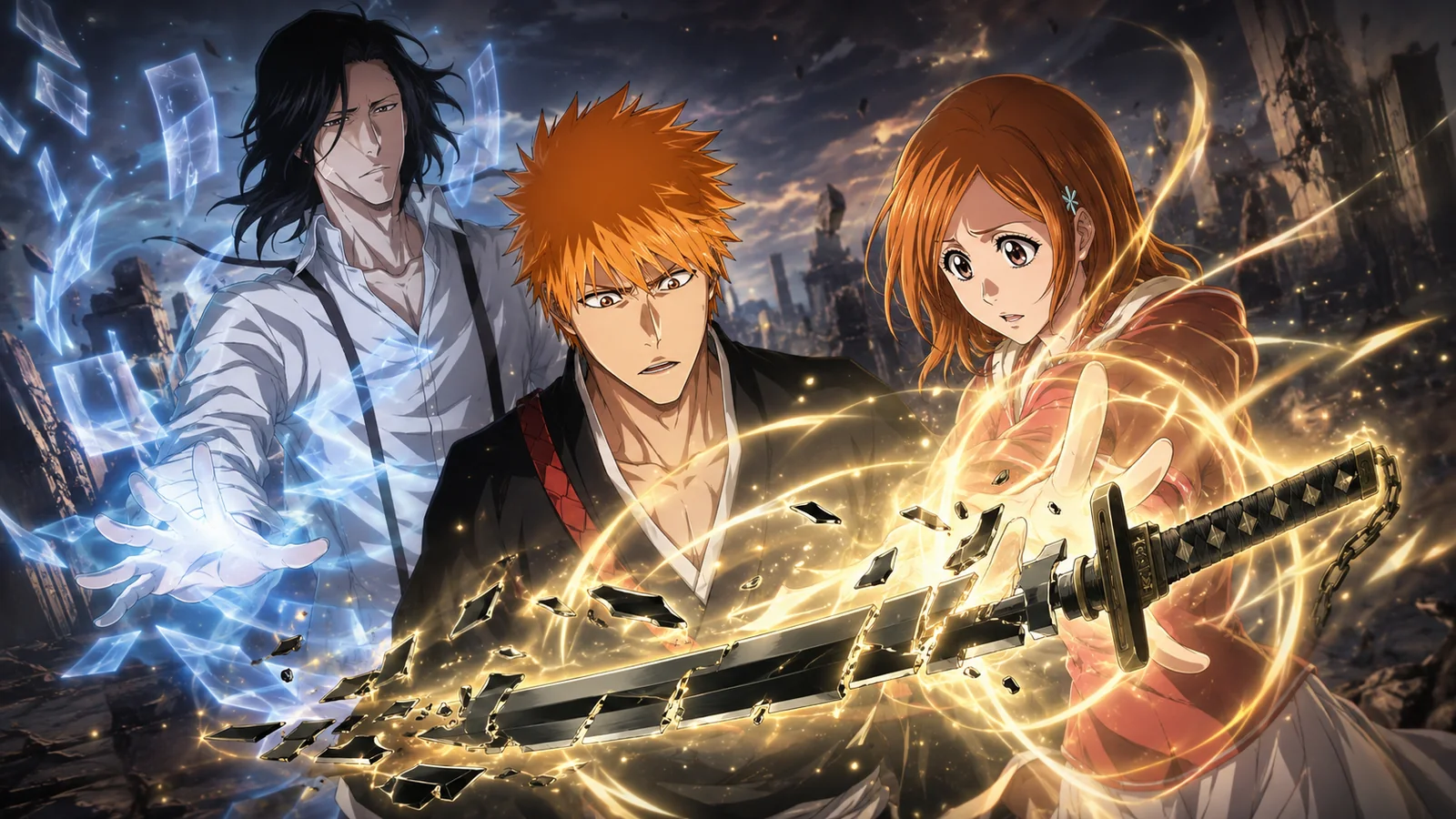
He stabs Ichigo with Book of the End and inserts a past in which Tensa Zangetsu was not broken by Yhwach. He is not overpowering The Almighty in a direct contest, and he does not erase every future Yhwach has seen. Instead, he creates the historical condition Orihime was missing: a past in which the Bankai exists intact.
This is why the combination works so neatly. Yhwach's power has attacked the future. Tsukishima manipulates the past.
Book of the End therefore does not need to "heal" the sword. Its job is to establish a past that gives Sōten Kisshun something viable to reject toward.
How Tsukishima Enables Orihime to Restore the Bankai
Once Tsukishima has inserted the new past, Orihime uses Sōten Kisshun again.
This time Tensa Zangetsu is restored.
The sequence matters because the two characters are doing different jobs. Tsukishima changes Ichigo's relevant past; Orihime performs the actual restoration. Neither character is shown simply overpowering Yhwach's entire ability.
A useful way to understand the mechanics is to separate the three states involved.
Yhwach uses The Almighty to establish a future in which the Bankai is broken. Orihime initially encounters that broken state and cannot reject the Yhwach-altered future that produced it. Tsukishima then inserts a past in which the Bankai was not broken. With that past now available, Orihime can reject the damage and restore the sword from the altered historical foundation.
This is a causal workaround rather than a raw-power victory.
It also fits the established identities of both abilities. Orihime rejects events. Tsukishima inserts himself into past events. Their powers overlap around history without being identical, and the final arc uses that overlap to counter a problem created by future manipulation.
Tsukishima Does Not Repair Tensa Zangetsu by Himself
A common simplification is that Tsukishima "fixes Ichigo's Bankai." That describes his importance to the outcome, but it is not the literal division of powers shown in the manga.
Book of the End supplies the altered past. Sōten Kisshun restores the Bankai.
That distinction also prevents another misconception: Tsukishima is not shown rewriting the whole world into a timeline where Yhwach never used The Almighty. His intervention is targeted through Ichigo. He inserts the necessary past so Orihime can act despite the future Yhwach created.
Ginjō's presence is important narratively rather than mechanically. He and Tsukishima arrive because of the debt they owe Ichigo after the events surrounding Xcution and the Fullbringers. The restoration gives those characters a concrete role in the final war without suddenly granting them a new ability designed only for Yhwach.
The manga also does not establish that Book of the End permanently cancels The Almighty as a whole. Yhwach remains the central threat afterward. The scene demonstrates a workaround for Tensa Zangetsu's specific condition, not a universal method for neutralizing every future Yhwach can alter.
Is This the Same as the Rule That a Broken Bankai Cannot Be Repaired?
No. Two different Bankai problems are easy to conflate.
Earlier in the Thousand-Year Blood War, Jugram Haschwalth breaks Ichigo's original Tensa Zangetsu. Mayuri explains that a Bankai that has been broken generally cannot simply return to its former state. That crisis ultimately sends Ichigo to Ōetsu Nimaiya, where Zangetsu is reforged rather than casually repaired.
The later Yhwach scene involves Ichigo's newly forged Tensa Zangetsu and a different obstacle. Orihime actively attempts to use Sōten Kisshun on it, and Tsukishima explains why her rejection cannot overcome the future Yhwach changed. After Book of the End supplies the altered past, Orihime succeeds.
Therefore, the normal "broken Bankai" rule is not the best explanation for her initial failure in this scene. If that rule alone made restoration impossible, Tsukishima's manipulation of the past would not address the problem the manga explicitly sets up.
The final sequence is specifically about The Almighty's effect on causality and the interaction between future alteration, past insertion, and Orihime's rejection.
Manga and Anime Tell the Final Battle Differently
The restoration described here belongs to the manga's final battle in Volume 74. Tsukishima changes the relevant past with Book of the End; Orihime then performs the restoration. The two powers have different jobs.
The TYBW anime expands that confrontation. Episode 45, "DEFEND YOU," adds Orihime's sacrifice, Episode 46 continues Ichigo's struggle in a changed world, and Episode 47, "THE END 2," carries his confrontation with Yhwach beyond the release of Bankai.
That anime progression is not a panel-for-panel timetable for the manga's repair scene. Ichigo using Bankai against Yhwach does not establish that Tsukishima's intervention has occurred, and the manga's solution should not be presented as an explanation of an anime scene with different events.
Orihime's sacrifice and her post-war manga life are also separate questions from repairing Tensa Zangetsu. Orihime's fate in Bleach distinguishes those versions without treating either her return or her permanent anime death as automatic.
For the broken sword in the manga, the explanation remains specific: The Almighty obstructs Orihime's rejection, Book of the End supplies a different past, and Soten Kisshun restores the Bankai.