Is Orihime Dead in Bleach? Her TYBW Anime and Manga Fate Explained
No, Orihime is not dead. See what Bleach TYBW Episodes 45-48 confirm, how the anime differs from the manga, and why Chapter 686 settles her fate.

No. Orihime Inoue is not permanently dead in either the completed Bleach manga or the currently aired Thousand-Year Blood War anime. Episode 45, "DEFEND YOU," gives Orihime an anime-original apparent sacrifice against Yhwach, but Episode 46 does not keep that outcome as her permanent death. By Episode 48, Orihime is alive and actively helping Ichigo again. In the manga, there is even less ambiguity: she survives the war, later marries Ichigo, and is Kazui Kurosaki's mother.
The confusion comes from treating Episode 45's cliffhanger as the end of her story. It was a major departure from the manga's final-battle sequence, so manga knowledge alone could not explain the scene when it aired. The anime has now supplied its answer.
What Happens to Orihime in Episode 45?
Episode 45 puts Ichigo and Orihime directly in Yhwach's path as the collapse of the Three Worlds becomes immediate.
Orihime has spent much of the final battle doing what her power set is built for: protecting Ichigo and rejecting damage. "DEFEND YOU" pushes that role further, giving her an anime-original final stand framed as a sacrifice rather than an ordinary injury.
Her Shun Shun Rikka is not conventional healing magic. Orihime rejects phenomena, which lets her barriers restore things by denying the event that damaged them. Against Yhwach, the anime turns that principle into a desperate defensive and offensive choice.
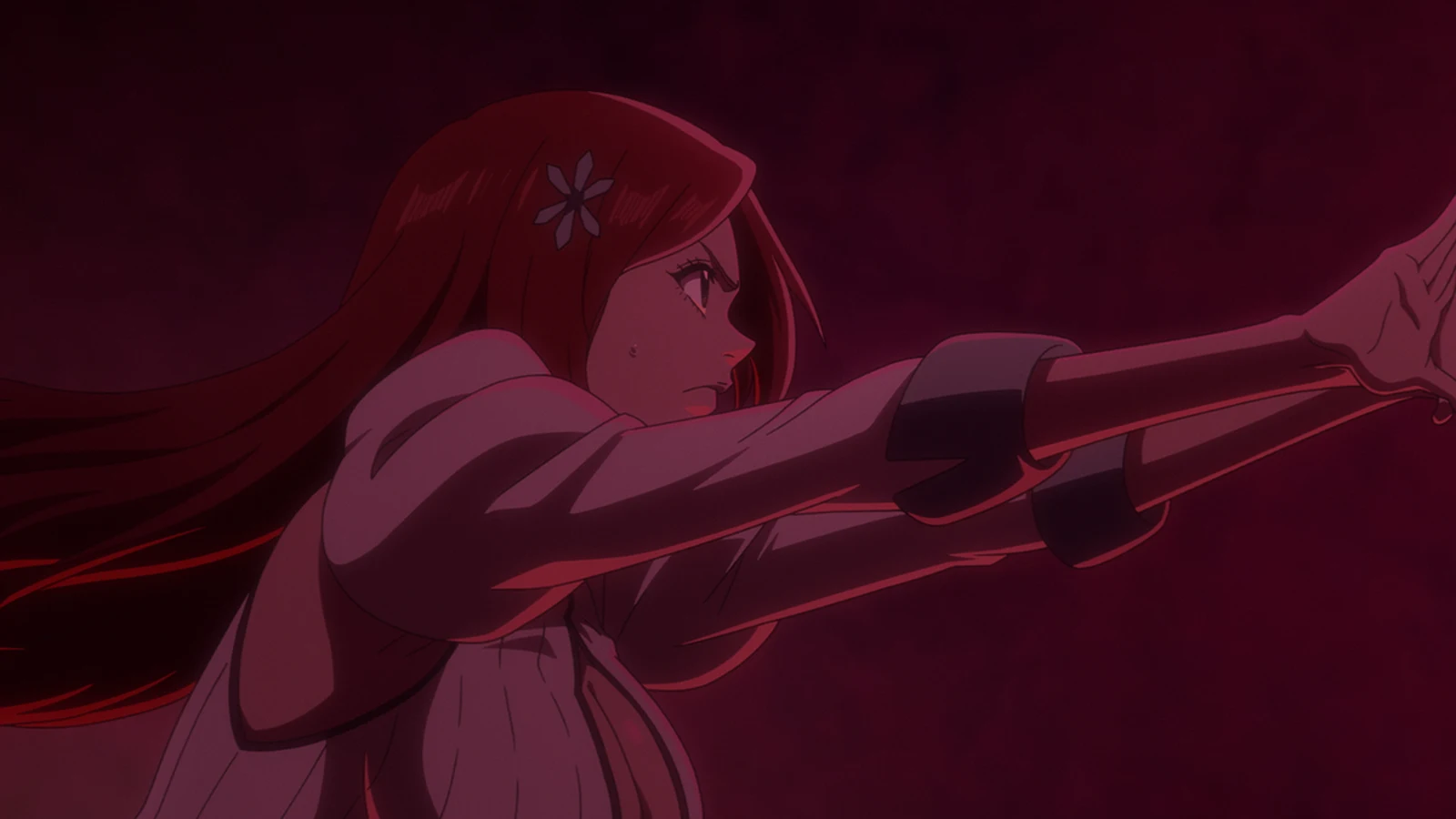
The ending makes the cost look fatal. Orihime disappears during the confrontation, and the episode deliberately leaves the impression that she may have traded her continued existence to protect Ichigo.
At the end of Episode 45 alone, "Orihime appears to die" was a reasonable reading. What is no longer accurate is stopping there.
Episode 46 Confirms It Was Not Permanent
Episode 46, "THE END," continues from the altered situation created by the cliffhanger. Orihime is not left permanently erased from the story.
The exact visual logic is tied to the anime's expanded handling of Yhwach's Almighty and its control over possible futures. What matters for Orihime's status is simpler: the anime does not keep the Episode 45 sacrifice as a permanent death.
This is an important correction because the final TYBW cour adds and rearranges material beyond Tite Kubo's manga chapter sequence. An anime-original event does not necessarily create a separate permanent ending for the character.
Episode 45 creates the apparent death. Episode 46 resolves the immediate uncertainty. Later episodes make her survival unmistakable.
Episode 48 Shows Orihime Alive and Helping Ichigo
By Episode 48, "THE END TWO WORLD," Orihime is active in the battle again.
Ichigo's Bankai has been broken through Yhwach's future-altering power. Orihime cannot simply reject the damage in the usual way when the break has effectively been established across the futures Yhwach controls.
Tsukishima creates the workaround. By inserting a different past with Book of the End, he gives Orihime a history in which the Bankai was not already broken in the same absolute way. Orihime can then use her rejection ability to restore Ichigo's blade.
That sequence is practical confirmation of her status: she is alive, conscious, using Shun Shun Rikka, and participating in the final battle after the Episode 45 cliffhanger.
For the mechanics, read why Orihime could not repair Ichigo's Bankai at first.
Does Orihime Die in the Manga?
No. The manga never gives Orihime the Episode 45 anime sacrifice. Its final battle follows a different sequence, and Chapter 686 establishes her post-war life directly.
Years after Yhwach's defeat, Orihime is alive and married to Ichigo Kurosaki. Their son is Kazui Kurosaki. Her survival is part of the completed ending rather than an inference from supplementary material.

The question therefore has two continuity-specific answers:
- Manga: Orihime survives the Thousand-Year Blood War and appears in the epilogue.
- TYBW anime: Episode 45 stages an apparent sacrifice, but subsequent episodes restore her to the ongoing story; she is alive in Episode 48.
The endpoints agree on survival even though the path is different.
Why the Manga Ending Did Not Initially Settle Episode 45
When an adaptation follows its source closely, readers can often use later chapters to answer an anime cliffhanger. That was less safe here.
The final TYBW cour contains substantial new material developed for the anime under Kubo's supervision. Episode 45's treatment of Orihime is one of those changes. Chapter 686 proved manga Orihime survived, but it could not explain how the anime would resolve an event that never occurred on the page.
Now that Episodes 46 through 48 have aired, the anime provides the missing evidence itself. Orihime's anime fate is no longer unresolved after Episode 45.
Why Orihime Could Protect Ichigo but Struggled With His Bankai
Orihime's power is flexible but not limitless. Santen Kesshun rejects attacks with a defensive barrier. Soten Kisshun rejects harmful events within a space, creating restoration that often resembles healing.
Yhwach's Almighty creates a different kind of problem. If he changes the future so an outcome is already broken across the relevant possibilities, Orihime lacks a clean event to reject back toward.
Tsukishima does not simply give her more power. He changes the history available to her, creating a past her rejection can use as a valid route to restoration.
That interaction is also why Episode 45 should not be reduced to "Orihime healed herself." The final battle is working with powers that alter causality, history, and futures. Her return is part of that supernatural conflict rather than routine recovery from a physical wound.
Anime, Manga, and Novel Continuity
The TYBW anime is the continuity in which the Episode 45 sacrifice exists. Its sequence moves from "DEFEND YOU"in Episode 45 to"THE END" in Episode 46 and Orihime's active survival by Episode 48. The final delayed episodes can still alter how the battle reaches its ending, but they no longer need to answer whether Episode 45 killed her permanently.
The manga is complete. Chapter 686 confirms Orihime survives, marries Ichigo, and has Kazui.
The Bleach light novels are supplementary stories rather than the source of Episode 45's sacrifice. They should not overwrite what the manga and TYBW anime depict directly.
There is no separate Bleach web-novel continuity. The meaningful comparison for this question is the manga against the TYBW anime.
Orihime Is Alive
Orihime's Episode 45 sacrifice is a real event in the anime, but it is not her permanent death.
She survives in the manga's completed continuity. The TYBW anime creates a more dramatic detour, then brings her back into the fight and has her help restore Ichigo's Bankai by Episode 48.
So the answer is now straightforward: Orihime is alive.
For other final-battle mechanics, see what the Still Silver arrow is and why Toshiro becomes an adult.