Rudeus's Magic Armor Explained: Every Canon Version
Every canon Rudeus Magic Armor explained, from Version One and Two to Version Zero and Three, including builders, limits, major uses, and anime status.

Rudeus has four canonically named personal Magic Armor models in the completed Mushoku Tensei light novels: Version One, Version Two, Version Zero, and Version Three. Readers also call them Mk I, Mk II, Mk Zero, and Mk III, so this guide uses both labels where useful.
The biggest misconception concerns Version Three. Version Three exists in canon. Version Zero also is not an early prototype despite its number. It is a late, extremely high-output weapon created for the final conflict.
Version One is the roughly three-meter suit Rudeus builds to fight Orsted. Version Two is the smaller, practical model he uses more often afterward. Version Three pursues Version One-class performance in a much more compact body. Version Zero goes in the opposite direction, sacrificing efficiency for overwhelming short-term performance.
Has Rudeus's Magic Armor Appeared in the Anime?
Through Mushoku Tensei Season 3 Episode 13, "Diary," the anime has reached the aftermath of Turning Point 4 and Rudeus reading the diary left by his future self. That diary is where the idea behind the Magic Armor enters the story.
The anime has not yet depicted the completed suit or Rudeus fighting Orsted in it by Episode 13.
Anime viewers currently have the setup, not the full armor storyline. Oldeus's disastrous future and the information he leaves behind become the foundation for what Rudeus does next. Our Turning Point 4 guide covers that transition, while the Future Rudeus timeline explains how Oldeus acquired the knowledge that changes Rudeus's path.
Everything below discusses later light-novel material through Volume 26.
Every Canon Magic Armor Version
| Canon name | Common label | Size and purpose | Main strengths | Main limits | Major use |
|---|---|---|---|---|---|
| Magic Armor Version One | Mk I | About 3 meters; original high-output combat suit | Enormous physical amplification, extreme durability, Stone Cannon Gatling Gun, shield, and absorption stone | Huge mana consumption, extremely bulky, difficult to transport | Built for Rudeus's battle against Orsted; reused in later major battles |
| Magic Armor Version Two | Mk II | Segmented black arm, leg, and torso armor; detuned Version One | Smaller and more mobile; later versions provide roughly Saint-tier physical ability | Considerably less powerful than Version One | Rudeus's practical everyday combat armor |
| Magic Armor Version Three | Mk III | Around 2 meters in its completed later-life form; efficiency-focused successor | Eventually achieves roughly Version One functionality in a smaller package | A difficult, long-running development project | Becomes the basis for General Purpose Magic Armor |
| Magic Armor Version Zero | Mk Zero | About 3 meters; specialized short-battle trump card | Much greater mobility and protection through enormous mana expenditure | Burns several times more mana and cannot operate efficiently for long | Rudeus's ultimate weapon against Fighting God Badigadi |
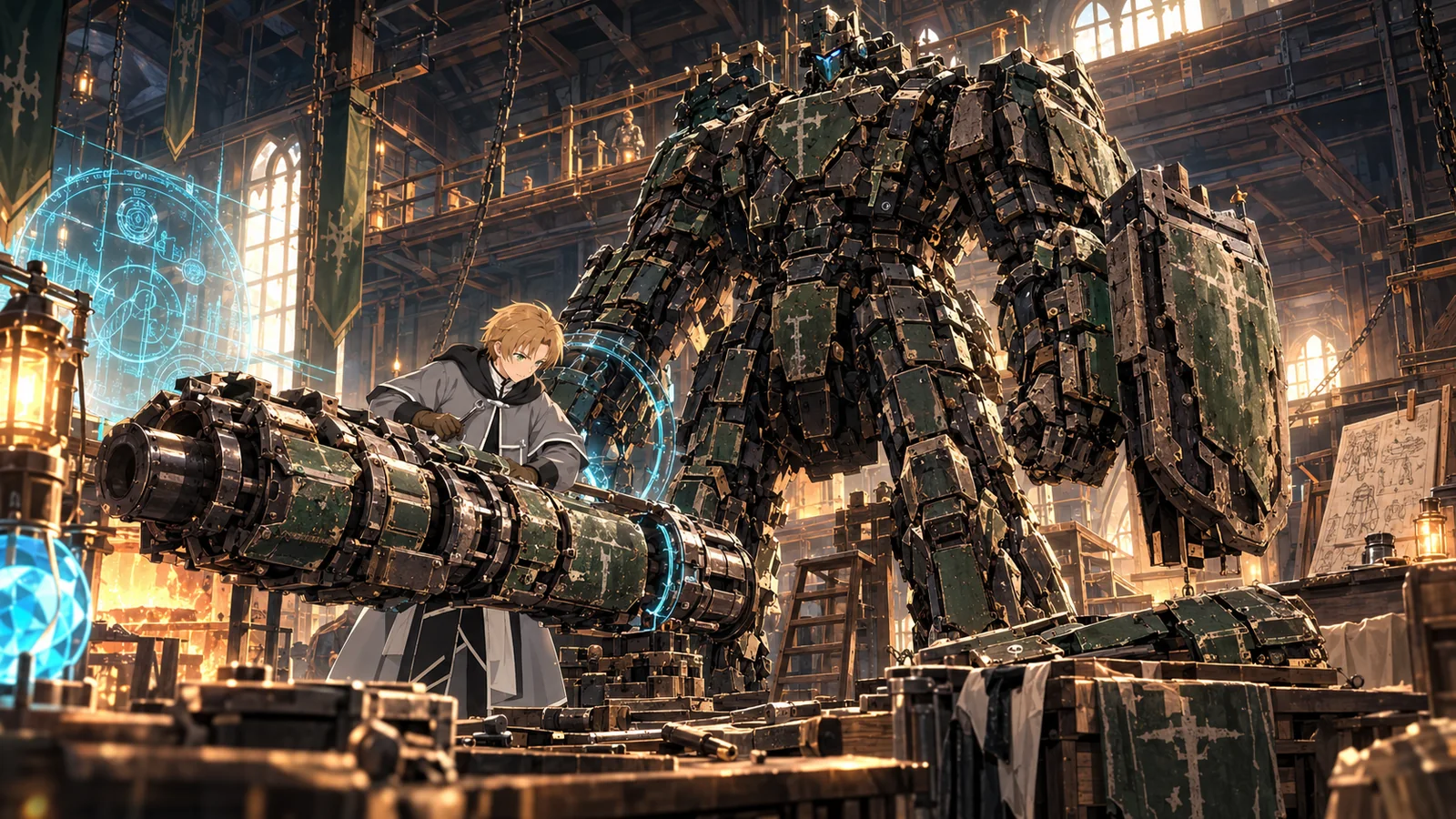
Version One: The Armor Used Against Orsted
Version One is the Magic Armor Rudeus wears when he fights Orsted. It is not Version Zero.
Rudeus develops Version One after Oldeus's diary shows him that a full-body magical suit can compensate for one of his greatest weaknesses. The finished armor stands around three meters tall and turns Rudeus from an exceptionally powerful long-range magician into someone capable of surviving physical exchanges far beyond his normal body.
Its weapons include the Stone Cannon Gatling Gun on the right, while its defensive equipment includes a shield and an absorption stone. Later records describe the suit's offense and defense as comparable to the realm of the Seven Great Powers. That does not mean armored Rudeus automatically equals every member of that group in a real fight.
The suit is specifically constructed for the confrontation explained in why Rudeus fights Orsted again. Orsted still overwhelms him, but Version One lets Rudeus survive and threaten an opponent he otherwise could not realistically engage at close range.
The Orsted battle is not the end of Version One. Rudeus continues using and reproducing it after becoming Orsted's subordinate. Its final destruction comes much later during the Battle of Biheiril against the Fighting God.
Version Two: Rudeus's Practical Armor
Version One solves the power problem but creates a logistics problem. It is enormous, mana-hungry, and awkward enough that simply having it available at the right place becomes a challenge.
Version Two is the answer.
Volume 26's character record describes it as a detuned model of Version One composed of separate black arm, leg, and body sections. It trades Version One's monstrous output for portability and everyday usefulness.
The design continues evolving. An early configuration provides useful physical reinforcement but falls short of Rudeus's ambitions. By Volume 18, supplementary magic circles are added to the torso to keep the limb sections from being torn away, producing the explicitly named Improved Version Two. Rudeus describes its power as rivaling a Saint-tier swordsman.
Later books refer to upgraded or updated Version Two armor. These are revisions of the same platform, not evidence for extra numbered models such as Version 2.5 or Mk IIB.
Roxy eventually adds another major enhancement: the Scroll Vernier, a back-mounted system that lets Rudeus trigger prepared magic scrolls rapidly. It expands what Version Two can do without turning the suit into another numbered armor.
Version Two is arguably the most useful armor in Rudeus's working life. Version One is the heavy weapon; Version Two is equipment he can realistically bring into ordinary dangerous situations.
Version Three: Yes, It Is Canon
This is where online terminology creates unnecessary confusion.
The completed light novel canonically names Magic Armor Version Three. Volume 26's retrospective record says Rudeus used it in his later years, that it stood around two meters tall, and that it possessed approximately the same functionality as Version One.
Development begins much earlier. By Volume 20, Rudeus, Zanoba, and Cliff have encountered serious difficulties trying to advance the technology. Volume 22 has Rudeus resume development of Version Three, with Zanoba joining the work and Roxy contributing her increasingly advanced knowledge of magic circles.
Its central design problem is efficiency: how do they preserve the giant Version One's capabilities without needing a three-meter machine that guzzles mana?
The later historical record confirms that the problem is eventually solved. Version Three also matters beyond Rudeus because it becomes the technological foundation for the General Purpose Magic Armor developed after him.
The accurate correction is simple: the exact English label may vary in fan discussion, but Magic Armor Version Three is canon.
Version Zero: The Late-Game Monster
Version Zero's name makes it easy to assume it came before Version One. It did not.
Version Zero appears near the end of the story as an extreme counterpoint to the efficiency-focused Version Three project. Instead of reducing mana consumption while preserving performance, Rudeus accepts vastly worse efficiency in exchange for much higher mobility and protection over a short period.
The original scene describes a roughly three-meter dark suit with a Gatling weapon on one side, a shotgun-style weapon on the other, and an additional magical blade capable of bypassing defenses. Its mana consumption is several times higher, but so are the mobility and armor available to Rudeus.
That makes it a short, decisive-battle weapon, not a general upgrade that replaces everything else.
Rudeus deploys Version Zero during the Battle of Biheiril against Fighting God Badigadi, who is wearing Laplace's Fighting God Armor. Orsted also supplies Rudeus with the King Dragon Blade Kajakut for the confrontation.
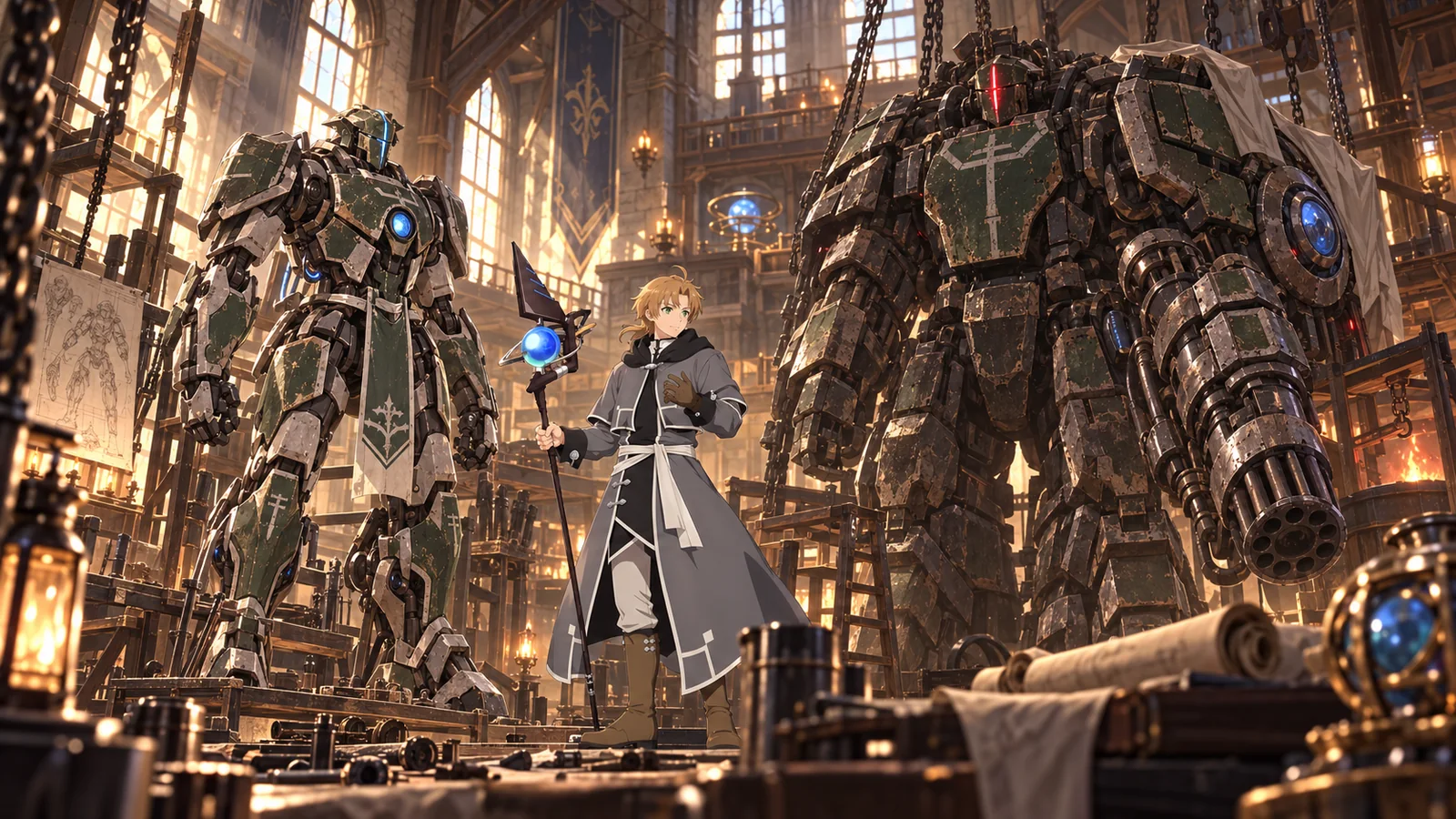
If the question is whether Rudeus uses Mk Zero against Orsted, the answer is no. The Orsted suit is Version One. Version Zero belongs to the much later Fighting God battle.
Why Does Rudeus Need Magic Armor?
Rudeus's problem has never been a shortage of magical energy. His problem is converting that enormous mana pool into the physical abilities elite warriors possess naturally.
He cannot envelop his body in Battle Aura in the normal way. That leaves a huge mismatch between his magical firepower and his body's close-range speed, strength, and durability.
Oldeus discovers the workaround after observing what happens when mana is supplied to the Zaliff Prosthesis: the artificial limb becomes dramatically stronger. The logical next step is applying the same principle to the entire body. The chronology of Rudeus's lost hand distinguishes this mana-powered replacement from his later biological recovery.
The Magic Armor is effectively a full-body magical prosthesis and powered suit. Rudeus pours mana into a mechanical and magical framework that supplies the physical enhancement his body cannot produce through Battle Aura.
That is also why its terrible efficiency is less crippling for Rudeus than it would be for almost anyone else. The Stone Cannon Gatling Gun and high-output armor would rapidly exhaust an ordinary magician, whereas Rudeus possesses the reserves to make the technology practical.
His vast mana is not an alternative to the armor. It is what makes the armor possible.
Who Builds Rudeus's Magic Armor?
Calling it solely Rudeus's invention undersells how collaborative the original project is.
Rudeus supplies the concept, his extraordinary mana, and the ultra-hard Earth-magic armor plates. He is also the only person capable of creating and repeatedly modifying those plates efficiently enough for the project.
Cliff Grimoire develops the control system from the principles behind the Zaliff Prosthesis. His magical-tool expertise is crucial to turning Rudeus's idea into something controllable.
Zanoba Shirone handles the armored shell and propulsion mechanisms. Oldeus's diary also credits Zanoba with helping develop the future version that inspired present-day Rudeus.
Roxy acts as the original project's general overseer. Her importance grows as the technology develops; by the Version Three project, her knowledge of magic circles is advanced enough for direct contribution. She also develops the Scroll Vernier used with Version Two.
Sylphie assists the original project as Roxy's helper, bringing silent Earth magic and useful knowledge of magic circles.
Even the Gatling Gun has a more specific production history than "Rudeus built it." Rudeus develops and uses the concept, while the later character record credits Ranoa's Magical Implement Director Jacqueline with creating the Stone Cannon Gatling Gun itself.
The armor is one of the series' clearest examples of Rudeus becoming stronger through engineering, research, and cooperation instead of unlocking a new personal spell.
What Happens After Version Three?
Rudeus's numbered personal line stops at the four names recorded in the completed 26-volume main story: Version One, Version Two, Version Zero, and Version Three. The main series does not establish a Magic Armor Version Four.
The technology continues. Rudeus's third daughter, Lily Greyrat, inherits the research. The later historical account credits her with completing General Purpose Magic Armor in year 483. That series is based on Version Three and makes armor technology useful beyond the one man with enough mana to power Rudeus's most extravagant designs.
That is the Magic Armor's larger significance. Version One begins as a desperate answer to Orsted. Version Two makes the idea practical. Version Three makes it efficient enough to become a technological foundation. Version Zero proves how far Rudeus can push the system when efficiency no longer matters.