Why Was Yuru Raised in Higashimura?
Yuru was raised in Higashimura because the village wanted to keep the Twin of Night close as a future Seal wielder, even after his parents tried to flee.

Yuru was raised in Higashimura because the village wanted to keep the Twin of Night under its control as the child expected to obtain the power of Seal. He was born there, but his continued upbringing in the hidden village was not simply his parents' preference. Mine and Nagisa eventually tried to escape with both Yuru and Asa after realizing the twins were being targeted. They managed to get Asa out, but circumstances forced them to leave Yuru behind. Higashimura then concealed that truth and used a Daemon impersonating Asa to keep Yuru emotionally tied to the village.
The village deception depends on Asa's real identity as Yuru's twin.
Spoiler warning: Major manga spoilers follow for Yuru and Asa's childhood, their parents, Higashimura's history, Break and Seal, and later revelations beyond the anime's current material.
Higashimura was preserving more than an old-fashioned way of life
At first, Higashimura looks like an isolated mountain community that has simply avoided modern civilization. Yuru grows up hunting with a bow and treating cars, phones, and city life as things outside his experience.
The manga gradually shows that the isolation is deliberate. Higashimura has been hidden behind a supernatural barrier for centuries, while selected retainers and affiliated families maintain contact with the "lowlands." The secrecy protects the settlement, its traditions, and especially the knowledge surrounding the special twins.
Higashimura is associated with the legend of a boy-and-girl pair born under the conditions that mark the "children who sunder day and night." Those twins can become candidates for two exceptional powers: Break and Seal.
Later manga material makes clear that preserving the possibility of producing such twins has been one of Higashimura's long-term obsessions. It would be too simple to say the village was created only for Yuru, but by the time Yuru and Asa are born, its ruling adults see them as assets tied to a centuries-old ambition.
Why Yuru and Asa were so valuable to the village
Yuru is the Twin of Night, while Asa is the Twin of Day. Their importance is not that they automatically command every Daemon from birth. Their potential lies in Break and Seal, paired powers connected to the boundary between life and death.
Asa's later experience establishes the brutal condition involved. After being killed, she encounters the entity associated with Break and is offered the choice to return with that power. Break can sever bonds, including contracts between Daemons and their masters.
Yuru is expected to face the corresponding possibility with Seal if he dies. Seal can bind or suppress, including returning Daemons to sealed relic states.
That is why factions interested in the twins repeatedly speak about killing them rather than merely training them. Death is treated as the gateway through which the relevant power may be obtained.
Crucially, resurrection is not guaranteed. The history of earlier twins proves the process can fail. Calling Yuru a "future Seal wielder" therefore describes Higashimura's plan, not an accomplished destiny.
Mine and Nagisa did try to take both children away
Yuru spends years believing his parents abandoned him, but later revelations overturn the simplest version of that story.
Mine was born in Higashimura and understood its customs. Nagisa was an outsider from Okinawa who accidentally reached the hidden village, married Mine, and became the mother of Yuru and Asa.
The turning point comes when Yuru is attacked while hunting with Mine. Mine saves him, recognizes the danger, and keeps the incident quiet while he and Nagisa prepare to leave. Their intention is to escape with both children.
Getting out is difficult because of the barrier and the village's control over access. Roei Tadera, from one of the retainer lines familiar with passage in and out, gives them the knowledge they need.
The escape fails in part. Mine and Nagisa get Asa out, but cannot retrieve Yuru in time. With the situation closing around them, they flee with Asa rather than lose the chance to save either child.
The exact minute-by-minute reason they could not recover Yuru is less fully explained than the larger fact: the manga explicitly rejects the idea that his parents calmly chose Asa over him.
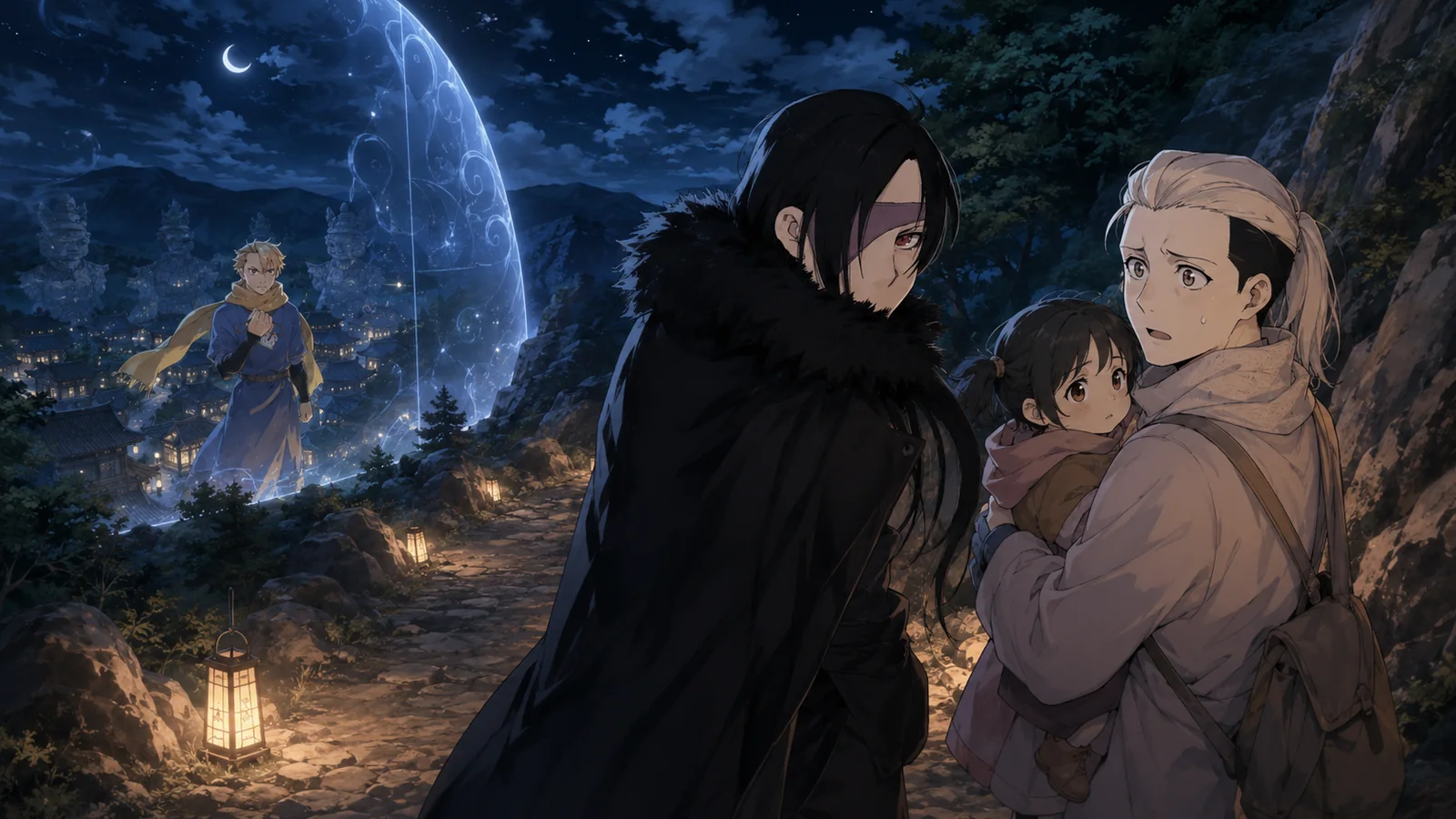
The fake Asa helped keep Yuru inside Higashimura
Once the real Asa was gone, Higashimura had a practical problem. If Yuru's sister vanished with his parents, he would have a powerful reason to question the village and eventually search for them.
The solution was deception.
The "Asa" Yuru grows up visiting is actually Kiri, one of Kyouka's Zashiki-Warashi Daemons. Kiri impersonates Asa and is presented as Yuru's frail, confined sister.
The arrangement gives Yuru an emotional anchor. He hunts for her, brings her food, worries about her condition, and structures his life around protecting the person he believes is his only close family member.
That does not mean Kiri's bond with Yuru is emotionally meaningless; the series treats Daemons as personalities rather than disposable illusions. But from the village leadership's perspective, the impersonation serves a coercive purpose: Yuru has a reason to stay.
This is one of the clearest answers to the title question. The adults responsible for the secret actively manufactured a family situation that discouraged Yuru from leaving or discovering what had happened.
Higashimura wanted an obedient Seal candidate
The village's treatment of Yuru becomes darker once the Break-and-Seal plan is stated openly.
Higashimura's adult insiders know that Yuru may need to die before he can claim Seal. Some extremists are willing to make that happen. They want the resulting power connected to the village and available for its ambitions.
That is why Yuru's upbringing matters strategically. A child who loves the village, identifies with its people, and knows little of alternatives is easier to imagine as a cooperative Seal wielder than someone raised freely in the modern world.
Mine's influence complicates that design. He teaches Yuru survival skills, composure, hunting, and independence. The same upbringing that makes Yuru useful also gives him the judgment and self-reliance to resist manipulation.
The manga does not say every villager personally designed this system. It distinguishes between leaders, extremists, retainers, people who accept the tradition, and figures such as Kyouka who become increasingly uncomfortable with it. Still, later revelations make it difficult to describe the adult community as wholly unaware of the twins' sacrificial role.
Left and Right complicate the plan for Yuru
Yuru's eventual contract with Left and Right changes the equation.
The two guardians worshiped in Higashimura are Daemons with a long history connected to the village. More importantly, they are natural counters to the twins' powers: Right can oppose Break, while Left can counter Seal.
That creates a problem for anyone trying to force Yuru into obtaining Seal. Yuru may be the Twin of Night, but he is already contracted to a being whose nature is hostile to Seal. Ivan even argues that Left may need to be removed.
Canon has not yet demonstrated exactly what would happen if Yuru died and attempted to contract with Seal while still bound to Left and Right. The possibility of rejection is raised, but it is not a settled rule.
This distinguishes prophecy from certainty. Higashimura behaves as though Yuru is a resource it can eventually activate. The actual Tsugai system is less obedient than the village's ideology assumes.
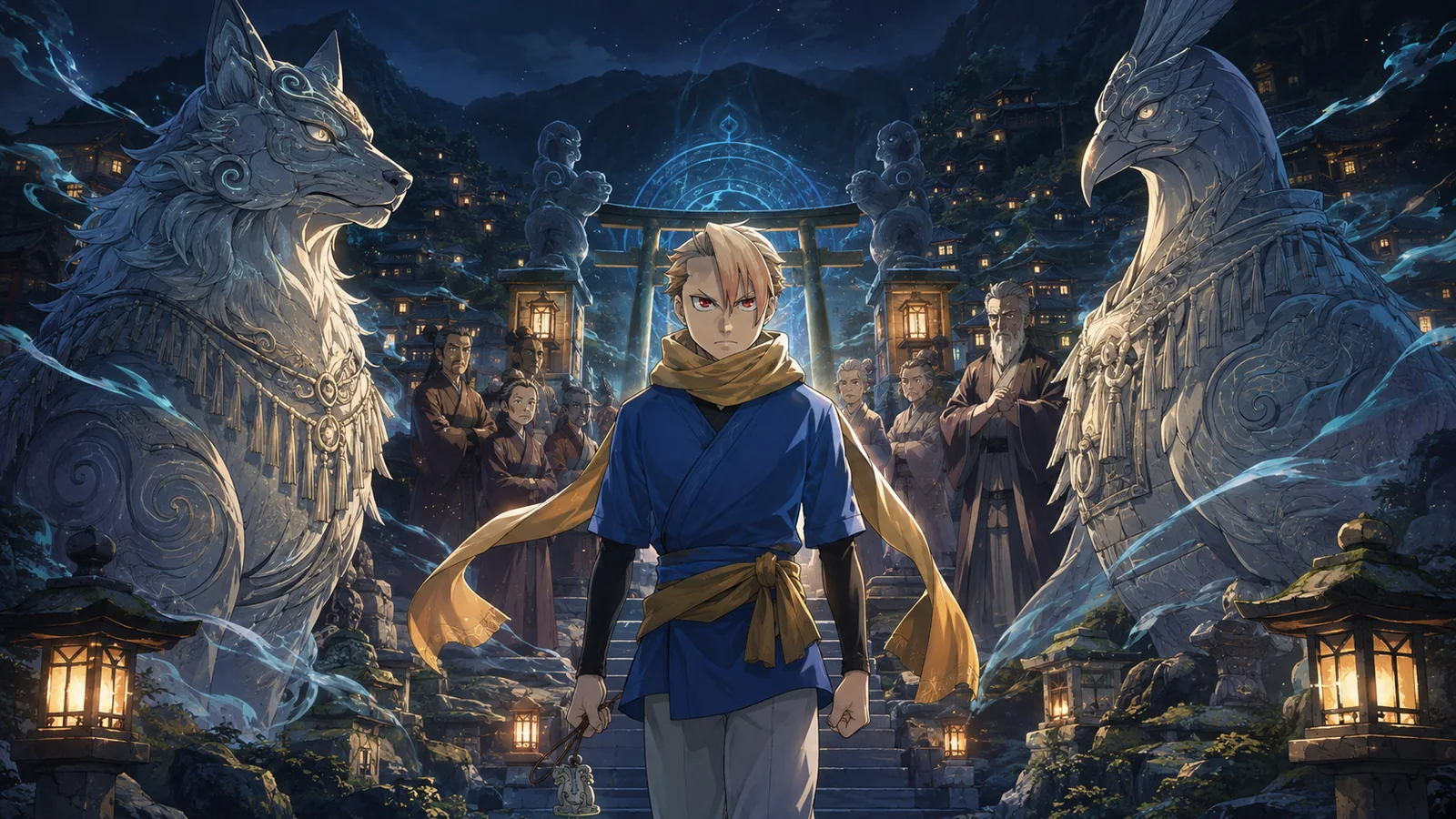
Higashimura's older history explains the cycle
The later manga reveals that Yuru and Asa are not the first twins Higashimura has tried to exploit.
Roughly four centuries earlier, the village lord Shimei Higashimura pursued Break and Seal through the fated twins Asahi and Yataro. He deliberately killed them so they could claim the powers. Asahi returned with Break; Yataro did not return as Shimei expected.
Shimei nevertheless used Asahi in warfare. After losing her, his desire to reproduce that power became even more destructive, leading to atrocities against other twins and helping fracture the community. Families that rejected the village's direction eventually left.
Yamaha's extraordinary longevity links the modern settlement directly to that past. The pursuit of Break and Seal is not merely an innocent tradition whose original meaning has vanished; the later manga shows an institutional memory of exploitation stretching into Yuru's era.
That history explains why his childhood is so controlled. To Higashimura's committed adults, Yuru represents another rare opportunity to obtain what earlier generations failed to secure.
What happened to Yuru's parents after the escape?
Mine and Nagisa initially find protection through the Kagemori family, while Asa remains under Kagemori protection. The parents later decide to travel to Okinawa, Nagisa's homeland, leaving Asa sheltered rather than exposing her to another journey.
They never arrive.
Mine, Nagisa, and the Kagemori escort traveling with them disappear during the flight. Later evidence connects their disappearance to Ivan Yosano and his sword Daemons. Left and Right detect traces associated with Yuru and Asa's parents on Ivan's weapons, and Ivan claims that he killed them.
That is still not an unambiguous on-page confirmation of their deaths. Ivan is manipulative, his Daemons have unusual spatial abilities, and his claim is made during a fight where provoking Yuru benefits him. As of the current manga material, the safest wording is that Mine and Nagisa are missing and strongly linked to Ivan's actions; the full circumstances have not been conclusively resolved.
The same caution applies to their motives. Canon confirms they wanted both children out and feared the danger surrounding the twins. It does not yet provide a complete private account explaining every choice during the escape or what they planned to do about Yuru afterward.
Manga canon goes further than the anime
The manga is the fullest source for Higashimura's purpose and the historical cycle behind Yuru's upbringing. Early material establishes the false Asa, the parents' escape, the Break-and-Seal danger, and Yuru's deliberate ignorance. Later volumes go much further into Yamaha, Shimei, the previous fated twins, and the village's long-running ambitions.
The 2026 anime adaptation has already revealed substantial parts of Yuru and Asa's childhood and their parents' disappearance, but as of August 16, 2026, it remains behind the later manga revelations about Higashimura's centuries-old history.
Even in the manga, however, some questions remain open. We know why Higashimura wanted Yuru close: he was the Twin of Night and a potential path to Seal. We know his parents tried to escape with both twins, and we know the fake Asa helped preserve the village's control over him.
What remains unresolved is more personal: the complete story of Mine and Nagisa's disappearance, every detail of the failed escape, and whether the old prophecy will unfold the way Higashimura expects. Yuru was raised as though his destiny belonged to the village; the story increasingly challenges that assumption.