Why Does Nanahoshi Get Sick?
Nanahoshi develops Dryne Syndrome because her Earth-born body cannot process accumulated mana. Here is how Sokas Grass treats her and why magic falls short.

Nanahoshi gets sick because her original Earth-born body is not adapted to living in a world saturated with mana. Over time, mana builds up inside her despite her inability to use magic normally, and that accumulation triggers the ancient illness called Dryne Syndrome in Seven Seas' English light novel translation. The name Drain Syndrome is also widely used in fan translations and reference material, but it refers to the same condition. In Volume 14, the illness becomes life-threatening until Rudeus and his companions find a way to remove the accumulated mana.
Her treatment depends on the resources and allies gathered by Perugius Dola.
Spoiler warning: Major spoilers follow for Mushoku Tensei light novel Volume 14, including Nanahoshi's collapse, Perugius, Kishirika, Atofe, and the treatment that keeps Nanahoshi alive.
Dryne Syndrome Is a Mana-Buildup Disease, Not Mana Exhaustion
The most important correction is that Nanahoshi is not getting sick because she has "run out" of mana. Dryne Syndrome works in the opposite direction: mana accumulates in a body that cannot safely process it.
Volume 14 presents the illness as something known from the distant past, when humans with extremely little mana capacity were vulnerable to the magical environment around them. As humanity changed over generations, the syndrome effectively disappeared from ordinary medical experience. That is why Nanahoshi's case initially seems so mysterious even to people surrounded by powerful magic users.
Nanahoshi is an unusual exception. She can use magic circles as part of her summoning research, but she cannot function as their normal mana source. She repeatedly relies on other people, especially Rudeus, to supply the enormous amount of mana her experiments require. Her body therefore has the strange combination that matters here: it is exposed to a mana-rich world while lacking the normal biological adaptation of people born there.
The syndrome is thus better understood as mana intolerance caused by accumulation, not as a magical energy deficiency. Healing magic can address injuries or some physical symptoms, but it does not solve the underlying buildup.
Nanahoshi's Earth Body Is the Key Difference
Nanahoshi and Rudeus both came from Japan, but their situations are biologically very different.
Rudeus was reincarnated. His mind carries memories from Earth, but his body is the body of Rudeus Greyrat, born in the Six-Faced World to local parents. From infancy, that body develops in an environment where mana is normal. Rudeus not only possesses mana; he eventually demonstrates an extraordinary capacity for it.
Nanahoshi was transported in her existing body. She did not receive a new body adapted to the world she arrived in. She retains the Earth-born body that crossed into the Six-Faced World rather than being reborn into its biology.
That difference is central to Volume 14's explanation of her illness. Her body resembles the kind of mana-incompatible human physiology that Dryne Syndrome historically affected. She can survive in the world for years, but exposure is cumulative. Eventually, the amount inside her becomes more than her body can tolerate.
This also gives her desire to return to Earth a harder edge. Nanahoshi already sees the Six-Faced World as somewhere she does not belong. Dryne Syndrome makes that feeling literal: her body itself is poorly suited to the world's magical environment.
What Symptoms Does Nanahoshi Show in Volume 14?
Nanahoshi's health does not go from normal to critical without warning. Her coughing becomes increasingly conspicuous, and the illness eventually escalates into a frightening physical collapse.
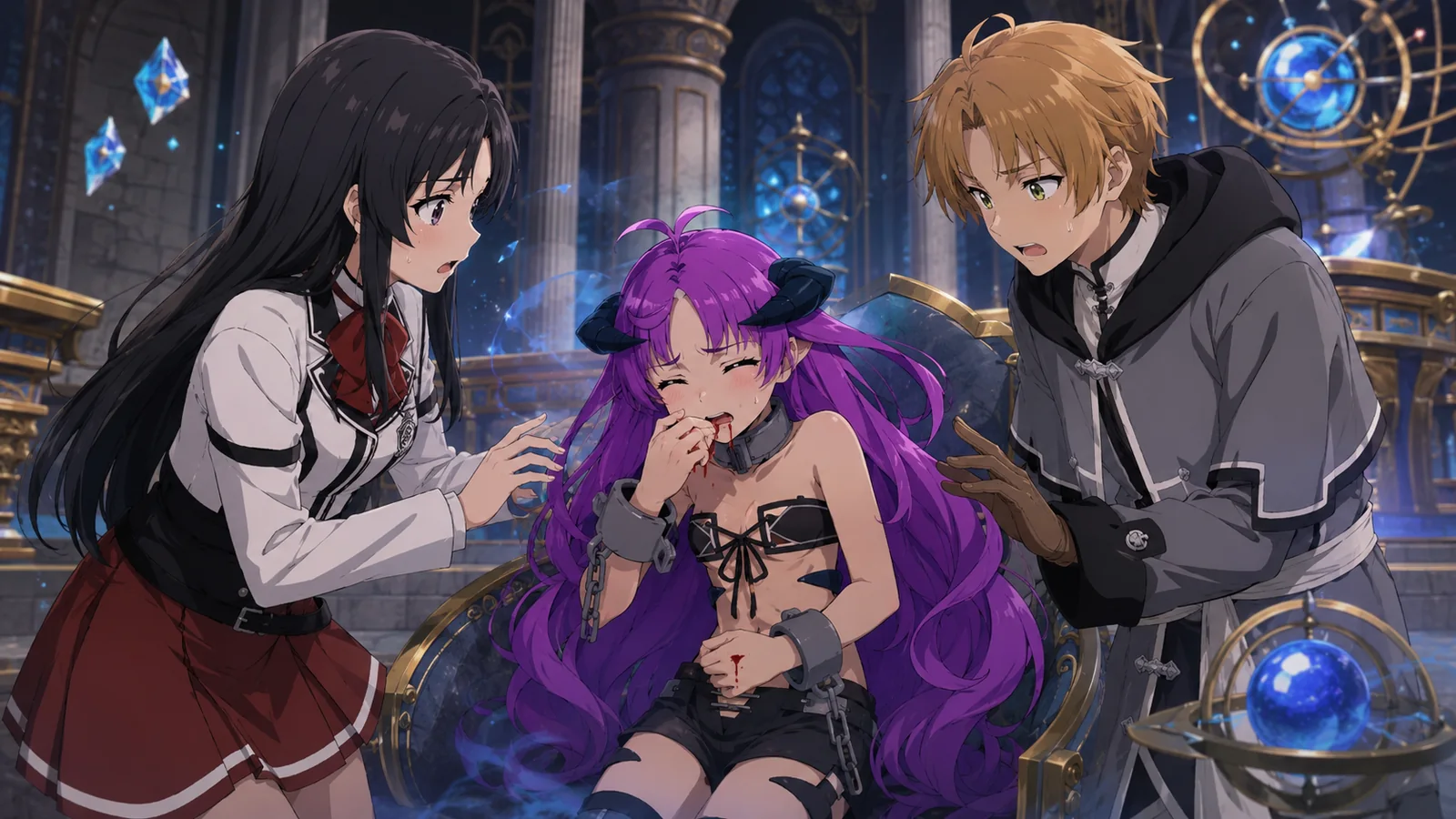
During the Volume 14 events surrounding Perugius's floating fortress, Nanahoshi suffers a severe coughing fit, coughs up blood, loses consciousness, and has to be taken for treatment. The scene is especially alarming because Sylphie has just tried to help her with healing magic, creating a moment of confusion over whether the spell somehow made things worse.
The later diagnosis clarifies that Sylphie is not the cause. Nanahoshi was already seriously ill. The blood and collapse are the result of Dryne Syndrome reaching an acute stage.
The symptoms fit the disease's underlying mechanism: her body is reacting badly to accumulated mana. She can be stabilized, but ordinary healing does not remove the thing causing the problem. This is why the story quickly shifts from treating a sick person to recovering medical knowledge that the modern world has largely forgotten.
Nanahoshi's collapse at Chaos Breaker exposes a problem ordinary healing magic cannot solve: her Earth-born body cannot handle this world's mana normally.
What Perugius Can and Cannot Do for Nanahoshi
Perugius Dola is essential to the solution, but he does not simply cast a spell that cures Nanahoshi.
His household has access to knowledge and abilities far beyond those of ordinary healers. Once Nanahoshi collapses, Perugius's side is able to identify her condition as the ancient Dryne Syndrome, and Yuruzu of Atonement helps keep her condition under control while the others search for an answer.
That distinction matters. The immediate treatment can stabilize Nanahoshi, but the accumulated mana remains the core problem. Neither standard healing nor detoxification magic provides a permanent fix.
Perugius also has priorities of his own and does not personally undertake the entire search for a cure. Rudeus refuses to accept that Nanahoshi may simply die, so he looks for someone old enough to remember an illness that vanished thousands of years ago.
That points him toward Kishirika Kishirisu.
Perugius still contributes indirectly in crucial ways. His teleportation network makes the expedition to the Demon Continent practical, and when Rudeus's group later becomes trapped in a dangerous confrontation with Immortal Demon King Atofe, Perugius intervenes and enables them to escape. He is therefore part of the rescue path without being the person who supplies the lost medical answer.
Why Kishirika Knows the Treatment
Kishirika is useful because Dryne Syndrome is ancient and she is one of the few beings with firsthand knowledge stretching back far enough to recognize what modern people have forgotten.
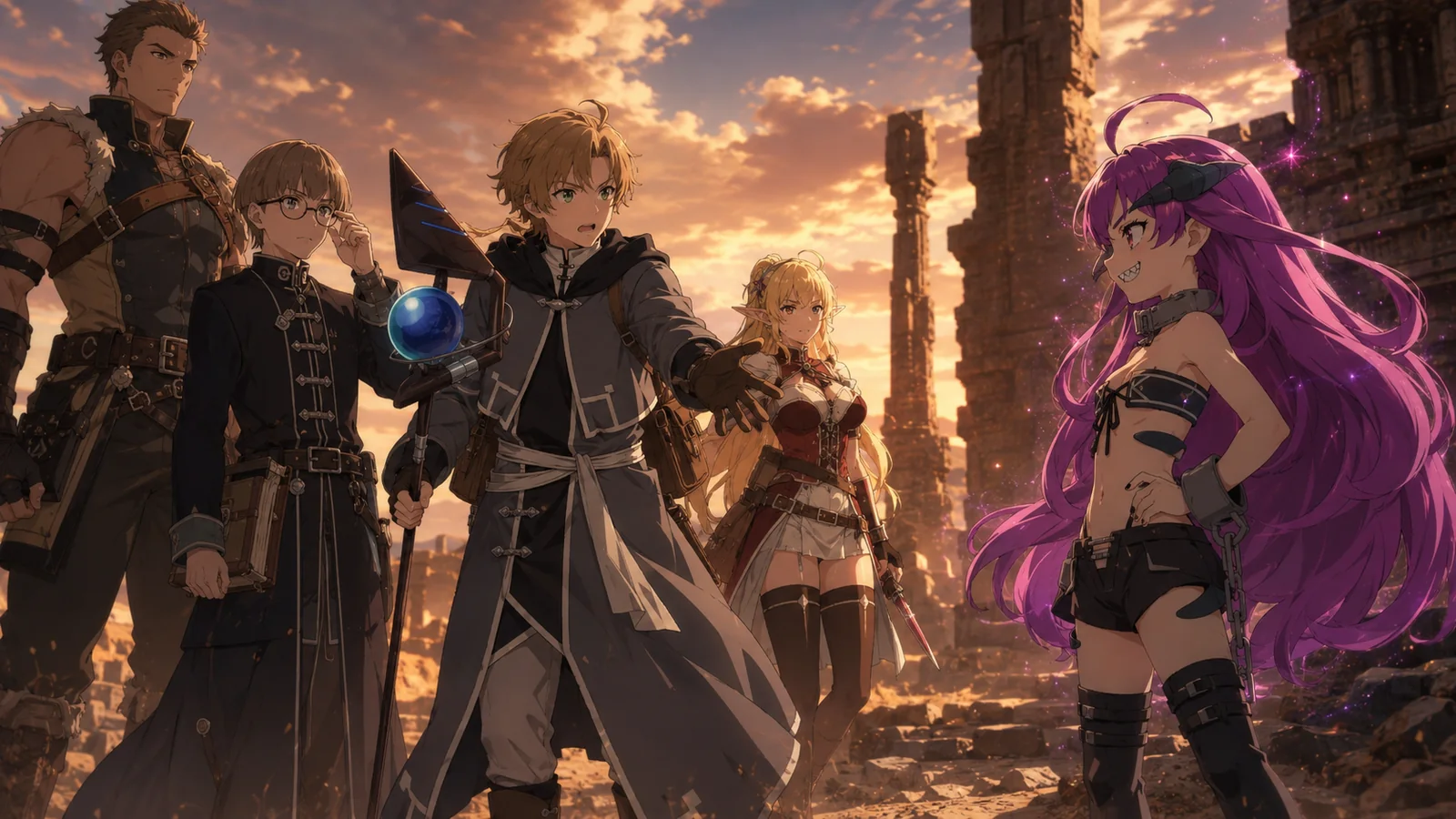
Rudeus travels to the Demon Continent with Cliff, Zanoba, and Elinalise to find her. Their search eventually succeeds, and Kishirika identifies Sokas Grass as the substance used to deal with the illness.
The remedy is simple in principle: the grass is prepared as tea, and it helps the patient's body expel the mana that has built up inside. That directly addresses what ordinary healing magic cannot. Rather than repairing damage while leaving the cause untouched, Sokas Grass reduces the dangerous accumulation itself.
Getting the herb is considerably harder than learning its name. Kishirika's information leads the group into territory connected with Atofe, whose idea of hospitality and reward creates a violent detour. Rudeus and his companions end up fighting for their freedom, and Perugius ultimately becomes involved in their escape.
The search therefore shifts from treating symptoms to finding Sokas Grass. That journey brings Rudeus's group into the Demon Continent's dangers while Nanahoshi needs the treatment.
Sokas Grass Treats the Syndrome but Does Not Cure It Permanently
When the group returns with Sokas Grass, Nanahoshi improves because the tea helps clear the mana that has accumulated inside her. That saves her from the immediate crisis, but Volume 14 does not establish a permanent cure.
This is an important distinction when describing her later status. Nanahoshi remains vulnerable because the basic incompatibility has not changed. She is still an Earth-born human living in a world where mana is ubiquitous, so mana can build up again after the previous accumulation has been removed.
Sokas Grass therefore becomes ongoing management rather than a one-time antidote. Later light-novel material explicitly continues to treat Dryne Syndrome as a chronic problem, with Nanahoshi regularly using the herb to manage it.
That is also why "Drain Syndrome" can be a slightly misleading English label if read too literally. Nothing is draining Nanahoshi of a useful mana reserve. The dangerous mana has to be drained from her because her body does not handle it correctly.
Her recovery after Volume 14 is real, but it is conditional. She has found a way to survive the illness, not a way to transform her body into that of someone naturally adapted to the Six-Faced World.
Why This Illness Matters to Nanahoshi's Story
Dryne Syndrome turns Nanahoshi's homesickness into more than a psychological conflict.
From her introduction, Nanahoshi is unusually resistant to treating the new world as a second home. She wants to reverse her displacement, avoids becoming deeply invested in local life, and devotes herself to summoning and teleportation research. Rudeus, by contrast, increasingly accepts the Six-Faced World as the place where his real life is happening.
Volume 14 gives that contrast a physical dimension. Rudeus possesses a body that belongs to this world even though his memories come from somewhere else. Nanahoshi possesses memories and a body from Earth. The world can nourish Rudeus's enormous magical potential while gradually poisoning Nanahoshi through the same underlying force.
It would be too strong to say that Dryne Syndrome proves every unusual aspect of Nanahoshi's existence is caused by her Earth physiology. Questions about her displacement, apparent aging, and the larger teleportation mystery involve separate pieces of the story. The confirmed point is narrower: her lack of normal mana adaptation makes her susceptible to the buildup that causes Dryne Syndrome.
That makes the illness one of the clearest examples of Mushoku Tensei treating isekai transportation as a physical event with consequences, rather than assuming an Earth human can enter a magical ecosystem without biological complications.
Light Novel, Web Novel, Manga, and Anime Continuity
For English-language canon, the clearest published version is the Seven Seas light novel. Volume 14 uses the name Dryne Syndrome, and Google Books' indexed text for that official edition likewise lists "Dryne Syndrome"and"Sokas Grass." "Drain Syndrome" remains common in web-novel-era translations, fan discussions, and reference pages, which is why both names circulate.
The web novel contains the same broad Nanahoshi illness storyline, but the light novel should be treated as the primary source when discussing the commercially published continuity and its official English terminology. The manga is another adaptation and should not be used to overwrite details established in the light novel simply because its pacing or presentation differs.
The anime's Chaos Breaker storyline connects this illness to the search for a treatment. The official Season 3 Episode 11 synopsis specifically names Dryne Syndrome and Sokas Grass after the group's encounter with Atofe. The explanation above follows the completed Volume 14 storyline, including the treatment's outcome; an episode preview establishes its setup, not every scene of the eventual adaptation.
The journey also leads into Turning Point 4, where a different illness threatens Roxy in Oldeus's future. Nanahoshi's Dryne Syndrome and Roxy's Magic Stone Disease are not the same condition.