Does Johnny Joestar Walk Again?
Johnny Joestar walks again by Steel Ball Run's manga ending. Follow his first leg movement, the final race, and why Spin is not a medical healing explanation.

Yes. Johnny Joestar walks again by the end of the Steel Ball Run manga. The closing chapter looks back on his journey as one in which he began walking again. That does not establish that Tusk ACT4 medically regenerated his spinal nerves. Spin is central to his progress, but the ending leaves the biological mechanism unexplained.
Spoiler scope: This article discusses the manga through volume 24, chapter 95, including the final battles and epilogue. It is not limited to the anime's opening premise.
Johnny's first leg movement is not a complete recovery
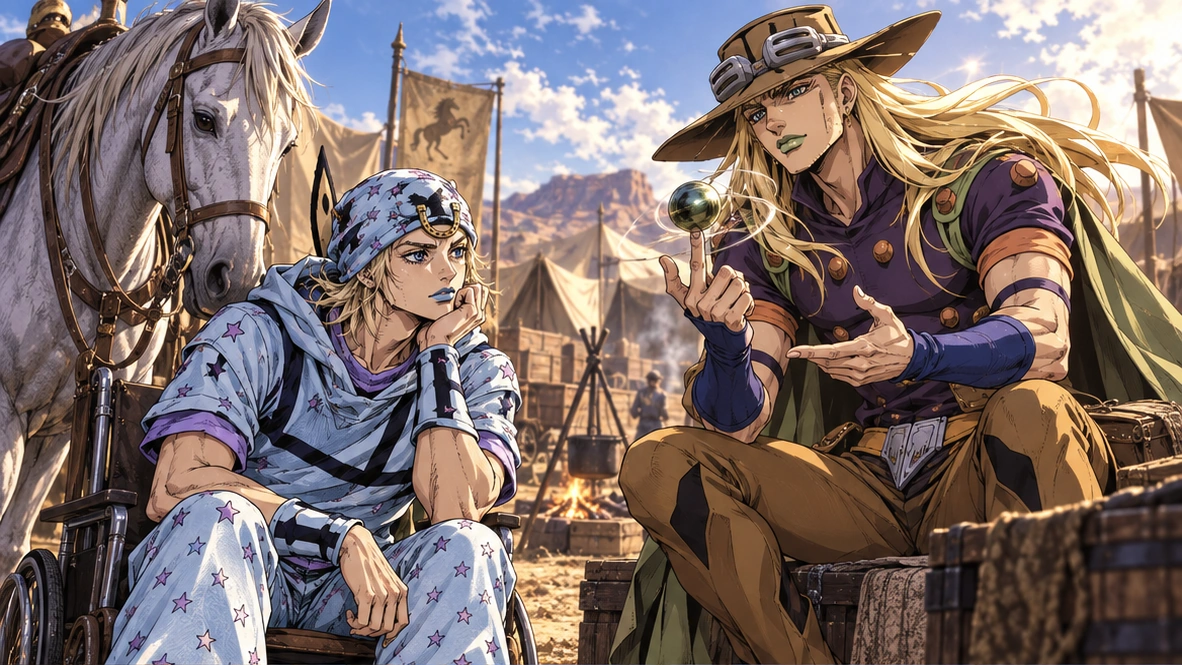
Johnny begins as a former genius jockey paralyzed from the waist down. Contact with Gyro Zeppeli's Steel Ball and its mysterious Spin makes his legs move, giving him a reason to enter the cross-country race: he wants to understand the phenomenon and regain the use of his legs.
That first movement is not the same as already being able to walk normally. Spin produces a startling response that gives him hope. Johnny still relies on his wheelchair, his horse Slow Dancer, and his developing command of Spin and Tusk.
The story separates the initial possibility from the outcome:
| Point in Johnny's journey | What it establishes |
|---|---|
| Before the race | Johnny cannot walk under his own power |
| First contact with Spin | His legs move, giving him hope rather than an immediate cure |
| Chapter 95's retrospective | Walking again is part of what his journey achieved |
The endpoint is not simply another isolated instance of someone applying Spin to Johnny's legs.
What chapter 95 says about the outcome
Shueisha's official volume 24 listing places "The World of Stars and Stripes - OUTRO" at chapter 95. The catalog verifies that chapter's placement, but it does not reproduce the full ending pages.
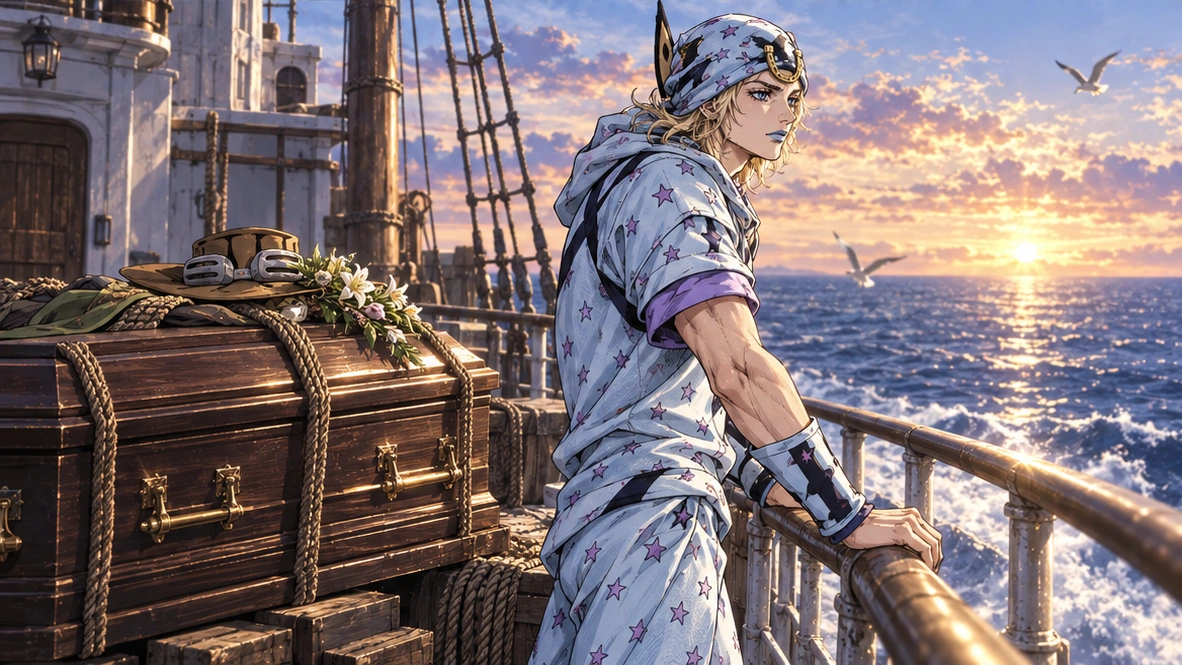
The ending account here draws on chapter summaries. JoJoWiki's recap describes Johnny reflecting on a journey during which he literally started walking again. That supports the physical-recovery reading, while the story's "walking" language also carries a thematic meaning.
It does not supply a clinical diagnosis or identify a nerve-healing power. Those are separate claims that should not be added to the answer about whether he walks.
The final Diego fight can make the chronology confusing
During the last fight with the alternate Diego Brando, Diego turns Johnny's own Infinite Rotation against him. Johnny is trapped by the same effect that Tusk ACT4 can impose on an enemy.
Chapter 95's recap describes Steven Steel returning with a horse and helping Johnny get mounted. Johnny then uses Tusk ACT4 to counter the Infinite Rotation affecting his own body and save himself.
That resolves an immediate attack from the Diego fight. It is not evidence that ACT4 regenerates the spinal nerves damaged before the race. The chapter's retrospective about walking concerns Johnny's broader journey, not a medical explanation of that rescue.
The surrounding antagonist conflicts are covered in Johnny and Diego's rivalry and Funny Valentine's betrayal of Johnny.
Did Tusk ACT4 repair Johnny's nerves?
That mechanism is not established by the ending. It is reasonable to connect Johnny's recovery with Spin: his first leg movement follows Gyro's demonstration, and his physical progress accompanies his growth as a Spin user. But "Tusk ACT4 regenerated his spinal cord" turns that connection into an unsupported technical explanation.
Tusk's abilities develop with Johnny's understanding of rotation. Countering Infinite Rotation is not, by itself, proof of regenerative medicine.
The distinction is simple: Johnny regains the ability to walk, and Spin belongs to the path that gets him there. The exact physiology should remain unspecified instead of becoming a fan-invented Stand rule.
Does Johnny need Spin every time he walks?
The ending does not establish such a requirement. The early Steel Ball scene is clearly Spin-triggered movement, but the final retrospective treats walking as an achieved part of Johnny's journey rather than describing an ability that switches off whenever rotation stops.
That is not a medical rule about his body after the race. It means the ending gives no basis for reducing the recovery to the opening scene's temporary effect or prescribing an ongoing mechanism it does not explain.
Walking is also the story's central metaphor
Johnny's recovery matters because Steel Ball Run treats walking as more than a physical objective. He has lost the career that defined him, carries bitterness about his family and his brother Nicholas, and struggles to imagine a direction for his life. His interest in Gyro's Spin begins with the hope of getting something back.
The race forces that desire into a larger journey. Johnny develops a friendship with Gyro, confronts his own ruthlessness, chooses what he is willing to sacrifice, and keeps moving after devastating loss. His physical progress accompanies that emotional change; it does not replace it.
That is why the ending can feel victorious even though Johnny does not collect every conventional prize. The race result is not the emotional measure of his story.
For the separate, spoiler-light entry-point question, see whether you can watch or read Steel Ball Run without the earlier JoJo Parts.